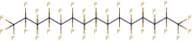
CAS 2264-03-1
:Perfluoropentadecane
Description:
Perfluoropentadecane, with the CAS number 2264-03-1, is a perfluorinated compound characterized by a long carbon chain fully substituted with fluorine atoms. This structure imparts unique properties, including high thermal stability, chemical inertness, and low surface tension. As a member of the perfluoroalkane family, it exhibits low reactivity and is resistant to degradation, making it persistent in the environment. Perfluoropentadecane is typically colorless and odorless, and it has a low boiling point compared to many organic compounds. Its hydrophobic and lipophobic characteristics make it useful in various applications, including as a surfactant, in coatings, and in specialized lubricants. However, due to environmental concerns associated with perfluorinated compounds, including potential bioaccumulation and toxicity, its use is subject to regulatory scrutiny. Overall, perfluoropentadecane exemplifies the unique properties of fluorinated hydrocarbons, which are leveraged in industrial applications while also raising awareness about their environmental impact.
Formula:C15F32
InChI:InChI=1/C15F32/c16-1(17,2(18,19)4(22,23)6(26,27)8(30,31)10(34,35)12(38,39)14(42,43)44)3(20,21)5(24,25)7(28,29)9(32,33)11(36,37)13(40,41)15(45,46)47
SMILES:C(C(C(C(C(C(C(C(F)(F)F)(F)F)(F)F)(F)F)(F)F)(F)F)(F)F)(C(C(C(C(C(C(C(F)(F)F)(F)F)(F)F)(F)F)(F)F)(F)F)(F)F)(F)F
Sort by
Purity (%)
0
100
|
0
|
50
|
90
|
95
|
100
Found 5 products.
Perfluoropentadecane
CAS:PerfluoropentadecanePurity:95%Color and Shape:SolidMolecular weight:788.11g/molDotriacontafluoropentadecane
CAS:Controlled ProductDotriacontafluoropentadecane is a chemical compound that belongs to the group of perfluoroalkyls. It is structurally related to crotonic acid, which has been shown to facilitate the reaction mechanism of radiation and fluorine. Dotriacontafluoropentadecane has been shown to be a good facilitator in polymerization reactions. The presence of phenyl groups on this molecule allows for its easy removal by hydrogenolysis. This compound can also react with oxygen to form an alkyl radical and a hydroxyl radical. Its spatial arrangement makes it suitable as a monomer or initiator for polymers, and its functional groups allow it to bind with other compounds, such as polymers or metal ions.
Formula:C15F32Purity:Min. 95%Molecular weight:788.11 g/mol