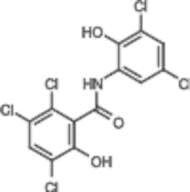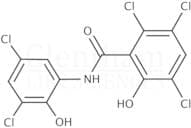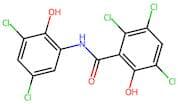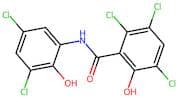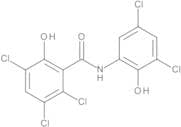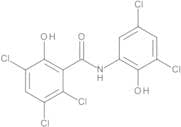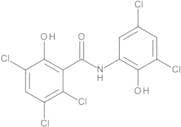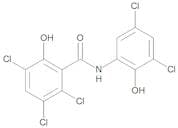
CAS 2277-92-1
:Oxyclozanide
Description:
Oxyclozanide is a chemical compound primarily used as an anthelmintic agent, particularly in veterinary medicine for the treatment of parasitic infections in livestock. It belongs to the class of compounds known as phenolic derivatives and is characterized by its ability to disrupt the energy metabolism of helminths, leading to their elimination from the host. Oxyclozanide is typically administered in the form of a white to off-white crystalline powder, which is relatively insoluble in water but soluble in organic solvents. Its mechanism of action involves interference with the oxidative phosphorylation process in parasites, making it effective against a range of flukes and other parasitic worms. Additionally, it has a favorable safety profile when used according to recommended dosages, although care should be taken to avoid overdosing. As with many veterinary pharmaceuticals, regulatory guidelines govern its use, and it is essential to adhere to withdrawal periods before the consumption of animal products to ensure food safety.
Formula:C13H6Cl5NO3
InChI:InChI=1S/C13H6Cl5NO3/c14-4-1-6(16)11(20)8(2-4)19-13(22)9-10(18)5(15)3-7(17)12(9)21/h1-3,20-21H,(H,19,22)
InChI key:InChIKey=JYWIYHUXVMAGLG-UHFFFAOYSA-N
SMILES:C(NC1=C(O)C(Cl)=CC(Cl)=C1)(=O)C2=C(Cl)C(Cl)=CC(Cl)=C2O
Synonyms:- 2,3,5-Trichloro-N-(3,5-dichloro-2-hydroxyphenyl)-6-hydroxybenzamide
- 2,3,5-trichloro-N-(3,5-dichloro-2-hydroxy-phenyl)-6-hydroxy-benzamide
- 3,3′,5,5′,6-Pentachloro-2,2′-dihydroxybenzanilide
- 3,3′,5,5′,6-Pentachloro-2′-hydroxysalicylanilide
- 3,5,6,3′,5′-Pentachloro-2,2′-dihydroxybenzanilide
- Benzamide, 2,3,5-trichloro-N-(3,5-dichloro-2-hydroxyphenyl)-6-hydroxy-
- Diplin
- Ici 46638
- Oxyclozanid
- Salicylanilide, 3,3′,5,5′,6-pentachloro-2′-hydroxy-
- Zanil
- Zanilox
- See more synonyms
Sort by
Purity (%)
0
100
|
0
|
50
|
90
|
95
|
100
Found 12 products.
Oxyclozanide
CAS:Oxyclozanide (Oxyclozanid) is a salicylanilide anthelmintic used in grazing animals for fasciola and cestode infestations.Formula:C13H6Cl5NO3Purity:99.28%Color and Shape:White To Yellowish PowderMolecular weight:401.46Oxyclozanide
CAS:Formula:C13H6Cl5NO3Purity:≥ 98.0%Color and Shape:White, off-white, pale beige or pale yellow powderMolecular weight:401.462,3,5-Trichloro-N-(3,5-Dichloro-2-Hydroxyphenyl)-6-Hydroxybenzamide
CAS:2,3,5-Trichloro-N-(3,5-Dichloro-2-Hydroxyphenyl)-6-HydroxybenzamidePurity:98%Molecular weight:401.46g/molOxyclozanide 1000 µg/mL in Acetonitrile
CAS:Controlled ProductFormula:C13H6Cl5NO3Color and Shape:Single SolutionMolecular weight:401.46Oxyclozanide
CAS:Applications Oxyclozanide, an anthelmintic drug displays strong in vivo and vitro activity against methicillin resistant S. aureus and Gram-positive bacteria Enterococcus faecium.
Not a dangerous good if item is equal to or less than 1g/ml and there is less than 100g/ml in the package
References Rajamuthiah, R., et al.: PLOS ONE, 10, 1-19 (2015)Formula:C13H6Cl5NO3Color and Shape:NeatMolecular weight:401.462,3,5-Trichloro-N-(3,5-dichloro-2-hydroxyphenyl)-6-hydroxybenzamide
CAS:Oxyclozanide is an antimicrobial agent that inhibits the enzyme activity of chitin synthase in the nematode, which is necessary for the production of chitin. This inhibition leads to disruption of the nematode's cell membrane and death. Oxyclozanide has been shown to be effective against resistant mutants, as well as synergistic with other antimicrobial agents. It is also a specific antidote for oxyclozanide poisoning.Formula:C13H6Cl5NO3Purity:Min. 95%Color and Shape:PowderMolecular weight:401.46 g/mol