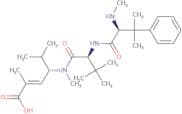
![N,β,β-Trimethyl-L-phenylalanyl-N-[(1S,2E)-3-carboxy-1-(1-methylethyl)-2-buten-1-yl]-N,3-dimethyl-L…](/_next/image/?url=https%3A%2Fstatic.cymitquimica.com%2Fcas-image%2Fthumb-webp%2F464767-n-b-b-trimethyl-l-phenylalanyl-n-1s-2e-3-carboxy-1-1-methylethyl-2-buten-1-yl-n-3-dimethyl-l-valinamide.webp&w=3840&q=75)
CAS 228266-40-8
:N,β,β-Trimethyl-L-phenylalanyl-N-[(1S,2E)-3-carboxy-1-(1-methylethyl)-2-buten-1-yl]-N,3-dimethyl-L-valinamide
Description:
N,β,β-Trimethyl-L-phenylalanyl-N-[(1S,2E)-3-carboxy-1-(1-methylethyl)-2-buten-1-yl]-N,3-dimethyl-L-valinamide, with CAS number 228266-40-8, is a synthetic compound that belongs to the class of amino acid derivatives. This substance features a complex structure characterized by multiple chiral centers, which contributes to its potential biological activity. The presence of the phenylalanine and valine moieties suggests that it may interact with biological systems, possibly influencing protein synthesis or enzyme activity. The compound's carboxylic acid and alkene functional groups indicate potential reactivity, making it of interest in medicinal chemistry and drug design. Its specific stereochemistry may also play a crucial role in its pharmacological properties, affecting binding affinity and selectivity for biological targets. As with many synthetic compounds, understanding its solubility, stability, and reactivity under various conditions is essential for applications in research and development. Further studies would be necessary to elucidate its full biological profile and potential therapeutic uses.
Formula:C27H43N3O4
InChI:InChI=1S/C27H43N3O4/c1-17(2)20(16-18(3)25(33)34)30(10)24(32)22(26(4,5)6)29-23(31)21(28-9)27(7,8)19-14-12-11-13-15-19/h11-17,20-22,28H,1-10H3,(H,29,31)(H,33,34)/b18-16+/t20-,21-,22-/m1/s1
InChI key:InChIKey=CNTMOLDWXSVYKD-PSRNMDMQSA-N
SMILES:[C@H](C(C)(C)C1=CC=CC=C1)(C(N[C@H](C(N([C@H](/C=C(/C(O)=O)\C)C(C)C)C)=O)[C@@](C)(C)C)=O)NC
Synonyms:- <span class="text-smallcaps">L</smallcap>-Valinamide, N,β,β-trimethyl-<smallcap>L</span>-phenylalanyl-N-[(1S,2E)-3-carboxy-1-(1-methylethyl)-2-buten-1-yl]-N,3-dimethyl-
- <span class="text-smallcaps">L</smallcap>-Valinamide, N,β,β-trimethyl-<smallcap>L</span>-phenylalanyl-N-[(1S,2E)-3-carboxy-1-(1-methylethyl)-2-butenyl]-N,3-dimethyl-
- Hti 286
- N,beta,beta-Trimethyl-L-phenylalanyl-N-[(1S,2E)-3-carboxy-1-(1-methylethyl)-2-butenyl]-N,3-dimethyl-L-valinamide
- N,β,β-Trimethyl-<span class="text-smallcaps">L</smallcap>-phenylalanyl-N-[(1S,2E)-3-carboxy-1-(1-methylethyl)-2-buten-1-yl]-N,3-dimethyl-<smallcap>L</span>-valinamide
- Spa 110
- L-Valinamide, N,β,β-trimethyl-L-phenylalanyl-N-[(1S,2E)-3-carboxy-1-(1-methylethyl)-2-buten-1-yl]-N,3-dimethyl-
- N,β,β-Trimethyl-L-phenylalanyl-N-[(1S,2E)-3-carboxy-1-(1-methylethyl)-2-buten-1-yl]-N,3-dimethyl-L-valinamide
- L-Valinamide, N,β,β-trimethyl-L-phenylalanyl-N-[(1S,2E)-3-carboxy-1-(1-methylethyl)-2-butenyl]-N,3-dimethyl-
Sort by
Purity (%)
0
100
|
0
|
50
|
90
|
95
|
100
Found 3 products.
L-Valinamide,N,b,b-trimethyl-L-phenylalanyl-N-[(1S,2E)-3-carboxy-1-(1-methylethyl)-2-butenyl]-N,3-dimethyl-
CAS:Formula:C27H43N3O4Purity:99.65%Molecular weight:473.6480Taltobulin
CAS:<p>Taltobulin is a nitrogen-containing analog that binds to the α subunit of the renal tubular adenylate cyclase and inhibits its activity. This results in decreased levels of cyclic AMP and less activation of protein kinases, which are important for regulating cellular functions. Taltobulin has been shown to inhibit cancer cells in culture as well as bladder and other cancers in animal studies. It also has minimal toxicity, with most side effects being mild and reversible. Taltobulin is used to treat autoimmune diseases such as lupus erythematosus, rheumatoid arthritis, and multiple sclerosis. Antibodies against taltobulin have been found in patients who were treated with this drug. These antibodies were found to be specific for the α subunit of the renal tubular adenylate cyclase and may be used as a diagnostic marker for patients who have been exposed to taltobulin or other similar drugs.</p>Formula:C27H43N3O4Purity:Min. 98 Area-%Color and Shape:PowderMolecular weight:473.65 g/molTaltobulin
CAS:Taltobulin (HTI-286) is a synthetic analog of the tripeptide cysteine, a microtubule protein inhibitor that inhibits liver tumor cell proliferation in vitro and tumor growth in vivo.Taltobulin is cytotoxic, induces mitotic arrest and apoptosis, and may be used in the study of breast cancer and microtubule tissue-related diseases.Formula:C27H43N3O4Purity:99.86%Color and Shape:SolidMolecular weight:473.65
![L-Valinamide,N,b,b-trimethyl-L-phenylalanyl-N-[(1S,2E)-3-carboxy-1-(1-methylethyl)-2-butenyl]-N,3-…](/_next/image/?url=https%3A%2Fstatic.cymitquimica.com%2Fproducts%2FIN%2Fthumb%2FDA00BF4U.jpg&w=3840&q=75)