

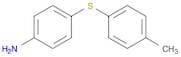
![4-[(4-methylphenyl)sulfanyl]aniline](/_next/image/?url=https%3A%2Fstatic.cymitquimica.com%2Fcas-image%2Fthumb-webp%2F248750-4-4-methylphenyl-sulfanyl-aniline.webp&w=3840&q=75)
CAS 22865-52-7
:4-[(4-methylphenyl)sulfanyl]aniline
Description:
4-[(4-Methylphenyl)sulfanyl]aniline, also known by its CAS number 22865-52-7, is an organic compound characterized by the presence of an aniline group substituted with a sulfanyl (thioether) moiety and a para-methylphenyl group. This compound features a sulfur atom bonded to a phenyl ring, which enhances its chemical reactivity and potential applications in various fields, including pharmaceuticals and materials science. The presence of the methyl group on the phenyl ring contributes to its hydrophobic characteristics, influencing its solubility and interaction with biological systems. The compound may exhibit properties such as moderate to high melting and boiling points, depending on its molecular interactions. Additionally, it may participate in various chemical reactions, including nucleophilic substitutions and electrophilic aromatic substitutions, due to the electron-donating nature of the aniline group. Safety data should be consulted for handling, as compounds with similar structures can exhibit toxicity or environmental hazards. Overall, 4-[(4-methylphenyl)sulfanyl]aniline is a versatile compound with potential applications in synthetic organic chemistry.
Formula:C13H13NS
InChI:InChI=1/C13H13NS/c1-10-2-6-12(7-3-10)15-13-8-4-11(14)5-9-13/h2-9H,14H2,1H3
SMILES:Cc1ccc(cc1)Sc1ccc(cc1)N
Synonyms:- Benzenamine, 4-[(4-Methylphenyl)Thio]-
- 4-[(4-METHYLPHENYL)SULFANYL]ANILINE
Sort by
Purity (%)
0
100
|
0
|
50
|
90
|
95
|
100
Found 4 products.
4-[(4-Methylphenyl)thio]aniline
CAS:4-[(4-Methylphenyl)thio]anilinePurity:95%Molecular weight:215.32g/mol4-[(4-methylphenyl)sulfanyl]aniline
CAS:4-[(4-Methylphenyl)sulfanyl]aniline is a heterocyclic organic compound that reacts with molecular oxygen to form an ionic liquid. The reaction system is catalytic and the byproduct of this reaction is a heterocycle. 4-[(4-Methylphenyl)sulfanyl]aniline has been shown to react with terminal oxidant and function as an oxidant to produce unsymmetrical amines. Advances in this area include the use of ionic liquids, which are liquids that are composed of ions, such as but not limited to salts, esters, or amides.Purity:Min. 95%

![4-[(4-Methylphenyl)thio]aniline](/_next/image/?url=https%3A%2Fstatic.cymitquimica.com%2Fproducts%2F54%2Fthumb%2FOR1004278.jpg&w=3840&q=75)

![4-[(4-Methylphenyl)thio]aniline](/_next/image/?url=https%3A%2Fstatic.cymitquimica.com%2Fproducts%2F10%2Fthumb%2FF064698.jpg&w=3840&q=75)

![4-[(4-methylphenyl)sulfanyl]aniline](/_next/image/?url=https%3A%2Fstatic.cymitquimica.com%2Fproducts%2F3D%2Fthumb%2FFM170009.jpg&w=3840&q=75)
