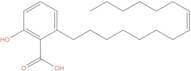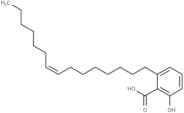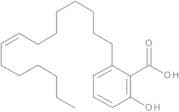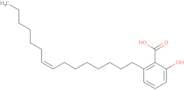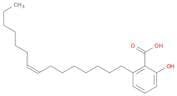
CAS 22910-60-7
:Ginkgolic acid
Description:
Ginkgolic acid refers to a group of compounds derived from the Ginkgo biloba tree, specifically known for their presence in the tree's leaves and seeds. The compound with the CAS number 22910-60-7 is one of the ginkgolic acids, characterized by its long-chain fatty acid structure with an amine group. These acids are typically unsaturated and exhibit a range of biological activities, including potential anti-inflammatory and antimicrobial properties. Ginkgolic acids are also noted for their ability to inhibit certain enzymes and may have implications in pharmacological research. However, they can be toxic in high concentrations, leading to concerns regarding their safety in dietary supplements derived from Ginkgo biloba. The presence of ginkgolic acids in herbal products has prompted regulatory scrutiny, emphasizing the need for careful dosage and quality control in their use. Overall, ginkgolic acids are significant in both natural product chemistry and potential therapeutic applications, warranting further investigation into their benefits and risks.
Formula:C22H34O3
InChI:InChI=1S/C22H34O3/c1-2-3-4-5-6-7-8-9-10-11-12-13-14-16-19-17-15-18-20(23)21(19)22(24)25/h7-8,15,17-18,23H,2-6,9-14,16H2,1H3,(H,24,25)/b8-7-
InChI key:InChIKey=YXHVCZZLWZYHSA-FPLPWBNLSA-N
SMILES:C(O)(=O)C1=C(CCCCCCC/C=C\CCCCCC)C=CC=C1O
Synonyms:- (15:1)-Anacardic acid
- (Z)-2-Hydroxy-6-(8-pentadecenyl)benzoic acid
- 1-Hydroxy-2-carboxy-3-(pentadecen-8′-yl)benzene
- 2-Hydroxy-6-(8Z)-8-pentadecen-1-ylbenzoic acid
- 2-Hydroxy-6-[(8Z)-pentadec-8-en-1-yl]benzoic acid
- 2-[(2E)-1-heptyl-7-hydroxyoct-2-en-1-yl]benzoic acid
- 22:1-ω<sup>7</sup>-Anacardic acid
- 6-(8-Pentadecenyl)salicylic acid
- 6-(8Z)-Pentadecenylsalicylic acid
- 6-(Z)-8-Pentadecenylsalicylic acid
- 6-[(8Z)-Pentadecenyl]-salicylic acid
- Anacardic acid monoene
- Benzoic acid, 2-hydroxy-6-(8-pentadecenyl)-, (Z)-
- Benzoic acid, 2-hydroxy-6-(8Z)-8-pentadecenyl-
- Ginkgoic acid
- Ginkgolic acid 15:1
- Ginkgolic acid C15:1
- Ginkgolic acid I
- Ginkgolicacid
- Romanicardic acid
- Salicylic acid, 6-(8-pentadecenyl)-, (Z)-
- See more synonyms
Sort by
Purity (%)
0
100
|
0
|
50
|
90
|
95
|
100
Found 10 products.
Ginkgolic acid
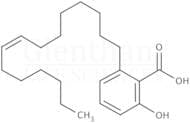
CAS:Formula:C22H34O3Purity:(HPLC) ≥ 98.0%Color and Shape:White to off-white powderMolecular weight:346.506-[8(Z)-pentadecenyl]-salicylic acid
CAS:Formula:C22H34O3Purity:>98%Color and Shape:In solution, EthanolMolecular weight:346.5Ginkgolic Acid
CAS:Ginkgolic Acid (Romanicardic acid) C15:1 represses curli genes and prophage genes in EHEC.
Formula:C22H34O3Purity:98.69% - 99.9%Color and Shape:White PowderMolecular weight:346.5Ginkgolic acid c15:1
CAS:Carboxylic acid with phenol functionFormula:C22H34O3Purity:≥ 95.0 % (HPLC)Color and Shape:PowderMolecular weight:346.51Ginkgolic Acid C15:1
CAS:Controlled ProductFormula:C22H34O3Color and Shape:NeatMolecular weight:346.50Ginkgolic acid (C15:1)
CAS:Ginkgolic acid (C15:1) is a bioactive compound, which is derived from the seeds and leaves of the Ginkgo biloba tree. It is known for its cytotoxic and antimicrobial properties, primarily acting as an inhibitor of various enzymatic activities. This compound functions by interfering with enzyme processes, disrupting cellular functions in target organisms. Ginkgolic acid is utilized in research focused on understanding and potentially manipulating these biological pathways. Its applications extend to studies examining its effects on cancer cell lines, where it has demonstrated the ability to induce apoptosis and inhibit cellular proliferation. Additionally, its antimicrobial characteristics are explored for developing novel pharmaceutical agents. While primarily of interest in the context of biochemical research, Ginkgolic acid also serves as a model compound for studying the ecological roles of natural plant toxins.Formula:C22H34O3Purity:Min. 95%Color and Shape:White PowderMolecular weight:346.5 g/molBenzoic acid, 2-hydroxy-6-(8Z)-8-pentadecenyl-
CAS:Formula:C22H34O3Color and Shape:SolidMolecular weight:346.5036


![6-[8(Z)-pentadecenyl]-salicylic acid](/_next/image/?url=https%3A%2Fstatic.cymitquimica.com%2Fproducts%2F48%2Fthumb%2F16-1501.jpg&w=3840&q=75)