CAS 2295-38-7
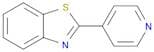
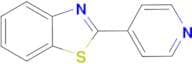
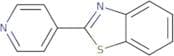
:2-(4-Pyridinyl)benzothiazole
Description:
2-(4-Pyridinyl)benzothiazole, with the CAS number 2295-38-7, is an organic compound characterized by its heterocyclic structure, which includes both a pyridine and a benzothiazole moiety. This compound typically appears as a solid and is known for its potential applications in pharmaceuticals and materials science due to its unique electronic properties. It exhibits moderate solubility in organic solvents, which can facilitate its use in various chemical reactions and formulations. The presence of the pyridine ring contributes to its basicity and potential for coordination with metal ions, while the benzothiazole component may impart biological activity, making it of interest in medicinal chemistry. Additionally, 2-(4-Pyridinyl)benzothiazole can participate in various chemical reactions, including electrophilic substitutions and nucleophilic additions, due to the reactivity of its functional groups. Safety data indicates that, like many organic compounds, it should be handled with care, using appropriate safety measures to avoid exposure.
Formula:C12H8N2S
InChI:InChI=1S/C12H8N2S/c1-2-4-11-10(3-1)14-12(15-11)9-5-7-13-8-6-9/h1-8H
InChI key:InChIKey=PDSIQRUYAXGTJG-UHFFFAOYSA-N
SMILES:C1(=NC=2C(S1)=CC=CC2)C=3C=CN=CC3
Synonyms:- 2-(4-Pyridinyl)benzothiazole
- 2-(4-Pyridyl)-1,3-benzothiazole
- 2-(4-Pyridyl)benzothiazole
- 2-(Pyridin-4-yl)benzo[d]thiazole
- 2-(Pyridin-4-yl)benzothiazole
- Benzothiazole, 2-(4-Pyridinyl)-
- Benzothiazole, 2-(4-pyridyl)-
- H 223
- NSC 38712
Sort by
Purity (%)
0
100
|
0
|
50
|
90
|
95
|
100
Found 3 products.
2-(4-Pyridyl)-1,3-benzothiazole
CAS:2-(4-Pyridyl)-1,3-benzothiazole is a pancreatic carcinogen. It has been shown to be an important factor in the development of pancreatic cancer. 2-(4-Pyridyl)-1,3-benzothiazole is a ligand for the nuclear receptor PPARγ and can activate this receptor by binding to it. Activated PPARγ then regulates gene expression and protein synthesis, leading to tumorigenesis. In addition, 2-(4-Pyridyl)-1,3-benzothiazole has been shown to inhibit the activity of methionine synthase and increase the amount of homocysteine in cells. This inhibition ultimately leads to cell death by increasing reactive oxygen species that can cause DNA damage or inhibit protein synthesis.Formula:C12H8N2SPurity:Min. 95%Molecular weight:212.27 g/mol