CAS 22991-03-3
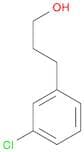
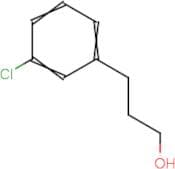
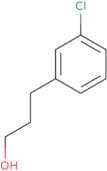
:3-(3-chlorophenyl)propan-1-ol
Description:
3-(3-Chlorophenyl)propan-1-ol, with the CAS number 22991-03-3, is an organic compound characterized by its structure, which includes a propanol backbone with a chlorophenyl group attached. This compound typically appears as a colorless to pale yellow liquid and is known for its moderate solubility in water, influenced by the presence of the hydroxyl (-OH) group. The chlorophenyl moiety contributes to its hydrophobic characteristics, while the alcohol functional group provides polar properties. This compound may exhibit biological activity, making it of interest in medicinal chemistry and pharmacology. Its synthesis often involves the reaction of a chlorophenyl compound with a suitable alkylating agent, followed by reduction processes. As with many organic compounds, safety precautions should be taken when handling it, as it may pose health risks if ingested or inhaled. Overall, 3-(3-chlorophenyl)propan-1-ol serves as a valuable intermediate in organic synthesis and has potential applications in various chemical industries.
Formula:C9H11ClO
InChI:InChI=1/C9H11ClO/c10-9-5-1-3-8(7-9)4-2-6-11/h1,3,5,7,11H,2,4,6H2
SMILES:c1cc(CCCO)cc(c1)Cl
Sort by
Purity (%)
0
100
|
0
|
50
|
90
|
95
|
100
Found 4 products.
Benzenepropanol, 3-chloro-
CAS:Formula:C9H11ClOPurity:97%Color and Shape:LiquidMolecular weight:170.63603-(3-Chlorophenyl)propan-1-ol
CAS:3-(3-Chlorophenyl)propan-1-olPurity:96%Molecular weight:170.64g/mol3-(3-Chlorophenyl)propan-1-ol
CAS:Formula:C9H11ClOPurity:97%Color and Shape:LiquidMolecular weight:170.643-(3-Chlorophenyl)propan-1-ol
CAS:<p>3-(3-Chlorophenyl)propan-1-ol is a chemical that is used as an intermediate in the synthesis of epoxides. It has been shown to be a useful asymmetric epoxidation reagent for the syntheses of natural products and pharmaceuticals. 3-(3-Chlorophenyl)propan-1-ol is typically used as a racemic mixture or as an enantiomerically pure compound. The use of this reagent allows for the synthesis of stereocenters with high levels of diastereoselectivity, which can then be converted into enantiomers.</p>Formula:C9H11ClOPurity:Min. 95%Molecular weight:170.64 g/mol