CAS 23003-35-2
:2-Bromo-3-hydroxy-6-methylpyridine
Description:
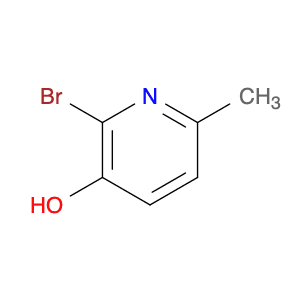
2-Bromo-3-hydroxy-6-methylpyridine is a heterocyclic organic compound characterized by its pyridine ring, which is a six-membered aromatic ring containing one nitrogen atom. The presence of a bromine atom at the second position, a hydroxyl group (-OH) at the third position, and a methyl group (-CH3) at the sixth position contributes to its unique chemical properties. This compound is typically a solid at room temperature and may exhibit moderate solubility in polar solvents due to the hydroxyl group, which can engage in hydrogen bonding. The bromine substituent can enhance the compound's reactivity, making it useful in various chemical reactions, such as nucleophilic substitutions. Additionally, the presence of the hydroxyl group may impart some degree of acidity, while the methyl group can influence the compound's steric and electronic properties. 2-Bromo-3-hydroxy-6-methylpyridine is of interest in medicinal chemistry and may serve as a building block for the synthesis of more complex molecules.
Formula:C6H6BrNO
InChI:InChI=1/C6H6BrNO/c1-4-2-3-5(9)6(7)8-4/h2-3,9H,1H3
SMILES:Cc1ccc(c(Br)n1)O
Synonyms:- 2-Bromo-6-methyl-3-pyridinol
- 2-Bromo-3-hydroxy-6-picoline
- 2-Bromo-6-Methylpyridin-3-Ol
- 2-Bromo-3-hydroxy-6-methylpyridine
- 3-Pyridinol, 2-bromo-6-methyl-
- 2-Bromo-3-hydroxy-6-methylpyridine ISO 9001:2015 REACH
- 2-Bromo-6-methyl-3-pyridinol ,97%
- 2-Bromo-6-methylpyridin-3-ol, 6-Bromo-5-hydroxy-2-picoline
Sort by
Purity (%)
0
100
|
0
|
50
|
90
|
95
|
100
Found 5 products.
3-Pyridinol, 2-bromo-6-methyl-
CAS:Formula:C6H6BrNOPurity:97%Color and Shape:SolidMolecular weight:188.02192-Bromo-3-hydroxy-6-methylpyridine
CAS:2-Bromo-3-hydroxy-6-methylpyridinePurity:98%Color and Shape:PowderMolecular weight:188.02g/mol2-Bromo-3-hydroxy-6-methylpyridine
CAS:Formula:C6H6BrNOPurity:97%Color and Shape:SolidMolecular weight:188.0242-Bromo-6-methylpyridin-3-ol
CAS:2-Bromo-6-methylpyridin-3-ol is a heterocyclic organic compound. It is a pyridine ring with two methyl groups attached to the ring at positions 2 and 6. The bromine atom is at position 3. This is an important intermediate in the Suzuki coupling reaction, which uses it as a starting material for the synthesis of many other compounds. The dieckmann condensation reaction produces this compound from 2,6-dichloropyridine and other reagents. Fluorescent when exposed to UV light, this compound has been used as a probe for chloride ions in solution using mass spectroscopy. This substance also yields dieckmann condensation products with alkynes and chlorine or bromine. 2-Bromo-6-methylpyridin-3-ol can be produced by treating pyridine with methylacrylate in the presence of catalysts such as copper(II)Formula:C6H6BrNOPurity:Min. 95%Molecular weight:188.02 g/mol