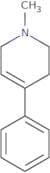
CAS 23007-85-4
:Pyridine, 1,2,3,6-tetrahydro-1-methyl-4-phenyl-, hydrochloride (1:1)
Description:
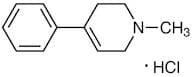
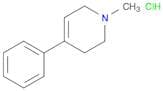
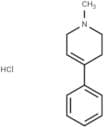
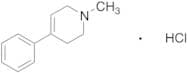
Pyridine, 1,2,3,6-tetrahydro-1-methyl-4-phenyl-, hydrochloride (1:1), with CAS number 23007-85-4, is a chemical compound that belongs to the class of tetrahydropyridine derivatives. It features a pyridine ring that has been saturated at specific positions, resulting in a bicyclic structure. The presence of a methyl group and a phenyl group contributes to its unique properties, including potential biological activity. As a hydrochloride salt, it is typically encountered in a solid form, which enhances its solubility in water and other polar solvents. This compound may exhibit various pharmacological effects, making it of interest in medicinal chemistry. Its characteristics include a relatively low melting point and moderate stability under standard conditions. The hydrochloride form is often used to improve the compound's handling and storage properties. Safety data should be consulted for proper handling, as with any chemical substance, to ensure safe laboratory practices.
Formula:C12H15N·ClH
InChI:InChI=1S/C12H15N.ClH/c1-13-9-7-12(8-10-13)11-5-3-2-4-6-11;/h2-7H,8-10H2,1H3;1H
InChI key:InChIKey=KOWJANGMTAZWDT-UHFFFAOYSA-N
SMILES:CN1CCC(=CC1)C2=CC=CC=C2.Cl
Synonyms:- 1-Methyl-4-Phenyl-1,2,3,6-Tetra-*Hydropyridine Hy
- 1-Methyl-4-Phenyl-1,2,3,6-Tetrahydropyridine Hydrochloride (1:1)
- 1-Methyl-4-phenyl-1,2,3,6-tetrahydropyridine hydrochloride
- Pyridine, 1,2,3,6-tetrahydro-1-methyl-4-phenyl-, hydrochloride
- Pyridine, 1,2,3,6-tetrahydro-1-methyl-4-phenyl-, hydrochloride (1:1)
Sort by
Purity (%)
0
100
|
0
|
50
|
90
|
95
|
100
Found 5 products.
1-Methyl-4-phenyl-1,2,3,6-tetrahydropyridine Hydrochloride
CAS:Formula:C12H15N·HClPurity:>98.0%(HPLC)Color and Shape:White to Light yellow powder to crystalMolecular weight:209.72Pyridine, 1,2,3,6-tetrahydro-1-methyl-4-phenyl-, hydrochloride (1:1)
CAS:Formula:C12H16ClNPurity:%Color and Shape:SolidMolecular weight:209.7151MPTP hydrochloride
CAS:MPTP hydrochloride is a precursor of MPP+, a dopamine neurotoxin with blood-brain barrier permeability.Formula:C12H16ClNPurity:96.35% - 99.98%Color and Shape:SolidMolecular weight:209.72Ref: TM-T4081
5mg34.00€1mL*10mM (DMSO)50.00€10mg52.00€25mg80.00€50mg131.00€100mg177.00€200mg281.00€500mg447.00€1-Methyl-4-phenyl-1,2,3,6-tetrahydropyridine Hydrochloride
CAS:Controlled ProductApplications 1-Methyl-4-phenyl-1,2,3,6-tetrahydropyridine hydrochloride is a dopaminergic neurotoxin that reportedly causes a severe and irreversible Parkinsonian condition in humans and monkeys.
Not a dangerous good if item is equal to or less than 1g/ml and there is less than 100g/ml in the package
References Burns, R.S., et al.: Proc. Natl. Acad.Sci. USA, 80, 4546 (1983), Langston, J.W., et al.: Science, 219, 979 (1983), Mogi, M., et al.: Neurosci. Lett., 250, 25 (1998), Przedborski, S. and Jackson-Lewis, V., Mov. Disord., 13, 35 (1998),Formula:C12H15N·ClHColor and Shape:NeatMolecular weight:209.721-Methyl-4-phenyl-1,2,3,6-tetrahydropyridine hydrochloride
CAS:Controlled Product1-Methyl-4-phenyl-1,2,3,6-tetrahydropyridine hydrochloride (MPTP) is a neurotoxin that causes Parkinson's disease in humans and animals. It is an analog of dopamine, which blocks the enzyme that breaks down dopamine. MPTP causes degeneration of dopaminergic neurons in the substantia nigra pars compacta, leading to clinical symptoms such as bowel disease, loss of motor control, and mood disorders. MPTP also affects the neurotransmitter gamma-aminobutyric acid (GABA), by inhibiting its production and release from nerve cells. The result is neuronal death through oxidative stress and inflammation. This drug has been shown to cause locomotor activity impairment in rats and mice due to its effect on the caudate putamen region of the brain. The clinical relevance of this finding is not yet known. MPTP is a neurotoxin that mimics natural compounds found in plants such asFormula:C12H15N·HClPurity:Min 98%Color and Shape:White PowderMolecular weight:209.71 g/mol