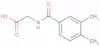
CAS 23082-12-4
:Dimethylhippuricacid; 98%
Description:
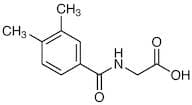
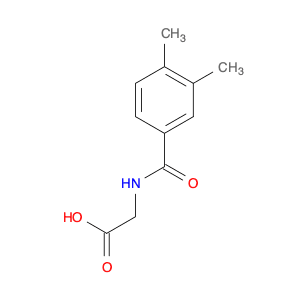
Dimethylhippuric acid, with the CAS number 23082-12-4, is an aromatic carboxylic acid characterized by its structure, which includes a benzene ring substituted with two methyl groups and a carboxylic acid functional group. It is a derivative of hippuric acid, formed by the methylation of the amino group. This compound is typically a white to off-white crystalline solid, soluble in organic solvents and sparingly soluble in water. Dimethylhippuric acid is often used in biochemical and toxicological studies, particularly as a biomarker for exposure to certain environmental pollutants, such as toluene. Its presence in biological samples can indicate the metabolism of aromatic compounds. The substance is generally handled with care in laboratory settings, as it may pose health risks if ingested or inhaled. Proper safety protocols should be followed when working with this chemical, including the use of personal protective equipment. Overall, dimethylhippuric acid serves as an important compound in environmental chemistry and toxicology research.
Formula:C11H12NO3
InChI:InChI=1/C11H13NO3/c1-7-3-4-9(5-8(7)2)11(15)12-6-10(13)14/h3-5H,6H2,1-2H3,(H,12,15)(H,13,14)/p-1
SMILES:Cc1ccc(cc1C)C(=O)NCC(=O)[O-]
Synonyms:- 3,4-Dimethylhippuric acid
- N-(3,4-dimethylbenzoyl)glycine
- {[(3,4-Dimethylphenyl)Carbonyl]Amino}Acetate
Sort by
Purity (%)
0
100
|
0
|
50
|
90
|
95
|
100
Found 5 products.
3,4-Dimethylhippuric Acid
CAS:Formula:C11H13NO3Purity:>98.0%(T)(HPLC)Color and Shape:White to Almost white powder to crystalMolecular weight:207.233,4-Dimethylhippuric Acid
CAS:Formula:C11H13NO3Purity:98%Color and Shape:SolidMolecular weight:207.22582-(3,4-Dimethylbenzamido)Acetic Acid
CAS:2-(3,4-Dimethylbenzamido)Acetic AcidPurity:98%Molecular weight:207.23g/mol3,4-Dimethylhippuric acid
CAS:3,4-Dimethylhippuric acid is a research chemical that has various applications in different industries. This compound is commonly used in the production of hydrogen fluoride and aluminum tetrahydrate. It is also used as a biomarker for assessing exposure to certain toxins, such as dendrotoxin and nicl2. 3,4-Dimethylhippuric acid can be detected using electrode emission techniques and is often used in fluorine and interferon studies. Additionally, it has been utilized in experiments involving tartaric acid, chloride solutions, naphthalene, and picolinic acid. Its versatility makes it a valuable tool for researchers across different fields.Formula:C11H13NO3Purity:Min. 95%Molecular weight:207.23 g/mol