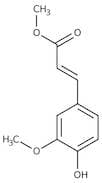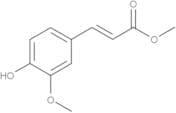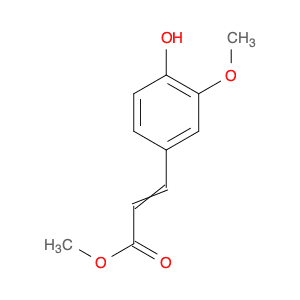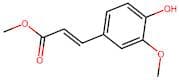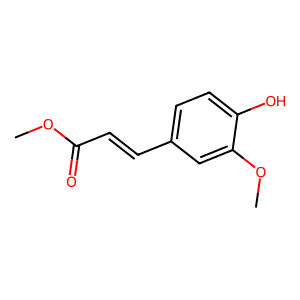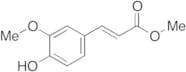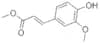
CAS 2309-07-1
:Methyl ferulate
- 2-Propenoic acid, 3-(4-hydroxy-3-methoxyphenyl)-, methyl ester
- 3-(4-Hydroxy-3-methoxyphenyl)-2-propenoic acid methyl ester
- Cinnamic acid, 4-hydroxy-3-methoxy-, methyl ester
- Ferulic Acid Methylester
- Ferulic acid methyl ester
- Methyl 3-(4-Hydroxy-3-Methoxyphenyl)Prop-2-Enoate
- Methyl 4′-hydroxy-3′-methoxycinnamate
- Methyl Ferulate
- NSC 74548
- methyl (2E)-3-(4-hydroxy-3-methoxyphenyl)prop-2-enoate
Methyl 4-hydroxy-3-methoxycinnamate, 99%
CAS:Methyl 4-hydroxy-3-methoxycinnamate has antioxidant activities that provide protection against inflammation and cancer. It has got the ability to cross cell membranes. It inhibits the release of pro-inflammatory cytokines. This Thermo Scientific Chemicals brand product was originally part of the AlfFormula:C11H12O4Purity:99%Color and Shape:White to pink, PowderMolecular weight:208.21Ferulic acid methylester
CAS:Ferulic acid methylester analytical standard provided with chromatographic purity, to be used as reference material for qualitative determination.Formula:C11H12O4Purity:(HPLC) ≥95%Color and Shape:PowderMolecular weight:208.222-Propenoic acid, 3-(4-hydroxy-3-methoxyphenyl)-, methyl ester
CAS:Formula:C11H12O4Purity:98%Color and Shape:SolidMolecular weight:208.2106Methyl 3-(4-hydroxy-3-methoxyphenyl)acrylate
CAS:Methyl 3-(4-hydroxy-3-methoxyphenyl)acrylateFormula:C11H12O4Purity:98.2% (Typical Value in Batch COA)Color and Shape: white solidMolecular weight:208.21g/molFERULIC ACID METHYL ESTER
CAS:FERULIC ACID METHYL ESTER (Methyl ferulate) is a hydroxycinnamic acid that is abundant in plants. FERULIC ACID METHYL ESTER has antioxidant activities.Formula:C11H12O4Purity:99.66% - 99.95%Color and Shape:SolidMolecular weight:208.21Ferulic Acid Methyl Ester
CAS:Controlled ProductApplications Ferulic Acid Methyl Ester is a derivative of Ferulic Acid (F308900), used as an antioxidant and food preservative. It has less antioxidant capacity than ferulic acid.
References Smart, M.G., et al.: Aust. J. Plant Physiol., 6, 485 (1979), Chen, C., et al.: J. Food Lipids, 2, 35,1995, Benzie, I., et al.: Anal. Biochem. 239, 70 (1996), Nardini, M., et al.: Food Chem., 79, 119 (2002), Lee, J., et al.: J. Agric. Food Chem., 52, 2647 (2004),Formula:C11H12O4Color and Shape:NeatMolecular weight:208.21Methyl 4-hydroxy-3-methoxycinnamate
CAS:Methyl 4-hydroxy-3-methoxycinnamate is a natural phenolic compound that is found in small quantities in many plants and foods. It is used to produce other compounds, such as vanillin, which are used as flavoring agents. Methyl 4-hydroxy-3-methoxycinnamate can be quantified using the enzymatic reaction of peroxidase with 3,4,5-trimethoxybenzene. The kinetics of this reaction have been studied by titration calorimetry. Aspergillus niger catalase has been shown to be sensitive to methyl 4-hydroxy-3-methoxycinnamate. Birch and oak wood lignocellulosic biomass can be converted into sugars through a hydrolysis process with methyl 4-hydroxy-3-methoxycinnamate. The carbohydrate content of birch and oak wood was reduced by approximately 60
Formula:C11H12O4Purity:Min. 95%Color and Shape:PowderMolecular weight:208.21 g/molMethyl 3-(4-hydroxy-3-methoxyphenyl)acrylate
CAS:Formula:C11H12O4Purity:98%Color and Shape:SolidMolecular weight:208.213