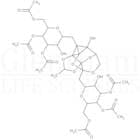
CAS 230963-26-5
:[(3aR,6S,7R,7aS)-2-[[(3aS,6R,7aR)-7-[[(3aS,6R,7S,7aR)-6,7-diacetoxy-5-(acetoxymethyl)-2-methyl-5,6,7,7a-tetrahydro-3aH-[1,3]dioxolo[4,5-b]pyran-2-yl]oxy]-6-hydroxy-2-methyl-5,6,7,7a-tetrahydro-3aH-[1,3]dioxolo[4,5-b]pyran-5-yl]methoxy]-6,7-diacetoxy-2-met
Description:
The chemical substance with the name "[(3aR,6S,7R,7aS)-2-[[[3aS,6R,7aR)-7-[[(3aS,6R,7S,7aR)-6,7-diacetoxy-5-(acetoxymethyl)-2-methyl-5,6,7,7a-tetrahydro-3aH-[1,3]dioxolo[4,5-b]pyran-2-yl]oxy]-6-hydroxy-2-methyl-5,6,7,7a-tetrahydro-3aH-[1,3]dioxolo[4,5-b]pyran-5-yl]methoxy]-6,7-diacetoxy-2-met" and CAS number "230963-26-5" is a complex organic compound characterized by its intricate stereochemistry and multiple functional groups. It features a dioxolo-pyran structure, which is indicative of its potential biological activity. The presence of multiple acetoxy groups suggests that it may have ester functionalities, which can influence its solubility and reactivity. The stereochemical configuration, denoted by the specific R and S designations, implies that the compound may exhibit chirality, potentially leading to different biological interactions depending on the enantiomer. Such compounds are often of interest in medicinal chemistry due to their potential therapeutic effects. Additionally, the presence of hydroxyl groups may enhance hydrogen bonding capabilities, affecting its interactions in biological systems. Overall, this compound's structural complexity suggests a rich area for further study in terms of its chemical behavior and potential applications.
Formula:C36H50O24
InChI:InChI=1/C36H50O24/c1-13(37)44-10-21-24(47-15(3)39)27(49-17(5)41)30-33(54-21)59-35(8,57-30)46-12-20-23(43)26(29-32(53-20)52-19(7)51-29)56-36(9)58-31-28(50-18(6)42)25(48-16(4)40)22(11-45-14(2)38)55-34(31)60-36/h19-34,43H,10-12H2,1-9H3/t19?,20?,21?,22?,23-,24+,25-,26?,27-,28+,29-,30+,31-,32-,33-,34+,35?,36?/m1/s1
Sort by
Purity (%)
0
100
|
0
|
50
|
90
|
95
|
100
Found 5 products.
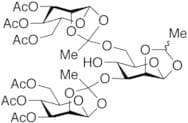
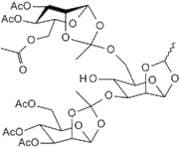
3,6-Di-O-(3,4,6-tri-O-acetyl-b-D-mannopyranosylethylidyne)-1,2-O-ethylidene-b-D-mannopyranose
CAS:Formula:C25H40O18Color and Shape:SolidMolecular weight:628.57433,6-Di-O-(3,4,6-tri-O-acetyl-β-D-mannopyranosylethylidyne)-1,2-O-ethylidene-β-D-mannopyranose
CAS:Controlled ProductApplications An intermediate for synthesis of bioactive oligosaccharides using 1,2-O-Ethylidene-α-D-gluco- and -β-D-Mannopyranose as the acceptors and acetobromo sugars as the donors via ortho ester intermediates.
References Sharp, J., et al.: J. Biol. Chem., 259, 11312 (1984),Cheong, J., et al.: Plant Cell, 3, 137 (1991), Mandal, D., et al.: Biochemistry, 33, 1157 (1994),Formula:C25H40O18Color and Shape:NeatMolecular weight:628.573,6-Di-O-(3,4,6-tri-O-acetyl-b-D-mannopyranosylethylidyne)-1,2-O-ethylidene-b-D-mannopyranose
CAS:3,6-Di-O-(3,4,6-tri-O-acetyl-b-D-mannopyranosylethylidyne)-1,2-O-ethylidene-b-D-mannopyranose is a synthetic glycoside that is used as an intermediate in the production of other compounds. It has been modified with fluorine to give it increased stability. This product is also known as 3,6:3',4',6'-di(1,2:1') ethylidene-.beta.-D-.mannopyranose and has CAS number 230963–26–5.Formula:C37H52O23Purity:Min. 95%Molecular weight:864.79 g/mol