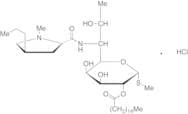
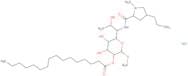
CAS 23295-14-9
:D-erythro-a-D-galacto-Octopyranoside, methyl6,8-dideoxy-6-[[(1-methyl-4-propyl-2-pyrrolidinyl)carbonyl]amino]-1-thio-,2-hexadecanoate, monohydrochloride, (2S-trans)- (9CI)
Description:
D-erythro-a-D-galacto-Octopyranoside, methyl 6,8-dideoxy-6-[[(1-methyl-4-propyl-2-pyrrolidinyl)carbonyl]amino]-1-thio-, 2-hexadecanoate, monohydrochloride, (2S-trans)- is a complex organic compound characterized by its unique structural features, including a pyrrolidine moiety and a thioether linkage. This compound is a derivative of a sugar, specifically a galactose-based structure, which contributes to its potential biological activity. The presence of the hexadecanoate group suggests that it may exhibit amphiphilic properties, making it relevant in various biochemical applications, including drug delivery systems. The hydrochloride form indicates that it is a salt, which can enhance its solubility in aqueous environments. Its specific stereochemistry, denoted by the (2S-trans) configuration, is crucial for its interaction with biological targets. Overall, this compound's intricate structure and functional groups may impart significant pharmacological properties, warranting further investigation in medicinal chemistry and related fields.
Formula:C34H64N2O7SClH
Synonyms:- D-erythro-D-galacto-Octopyranoside,methyl 6,8-dideoxy-6-(1-methyl-4-propyl-L-2-pyrrolidinecarboxamido)-1-thio-,2-palmitate, monohydrochloride, trans- a- (8CI)
Sort by
Purity (%)
0
100
|
0
|
50
|
90
|
95
|
100
Found 4 products.
Lincomycin 2-Palmitate Hydrochloride
CAS:Controlled ProductStability Hygroscopic
Applications Lincomycin 2-Palmitate Hydrochloride is a Lincomycin 2-monoester which shows highly active anti-bacterial properties.
References Morozowich, W. et al.: J. Pharm. Sci., 62, 1102 (1973);Formula:C34H65ClN2O7SColor and Shape:NeatMolecular weight:681.41Lincomycin 2-palmitate hydrochloride
CAS:Lincomycin 2-palmitate hydrochloride is a semi-synthetic antibiotic, derived from the natural antibiotic lincomycin through chemical modification. It is sourced from fermentative processes involving the bacterium *Streptomyces lincolnensis*. The compound exerts its action by inhibiting protein synthesis in susceptible bacteria. This occurs through its binding to the 50S subunit of the bacterial ribosome, thereby hindering peptide chain elongation and ultimately arresting bacterial growth.Formula:C34H65ClN2O7SPurity:Min. 95%Molecular weight:681.41 g/mol