CAS 232951-83-6
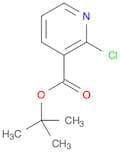
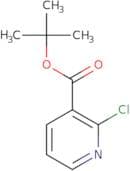
:tert-Butyl 2-chloronicotinate
Description:
Tert-Butyl 2-chloronicotinate is an organic compound characterized by its structure, which includes a tert-butyl group and a chloronicotinate moiety. It is a derivative of nicotinic acid, where the hydrogen at the 2-position is replaced by a chlorine atom, and the carboxylic acid group is esterified with tert-butanol. This compound typically appears as a colorless to pale yellow liquid or solid, depending on its purity and temperature. It is known for its potential applications in medicinal chemistry, particularly in the synthesis of various bioactive molecules. The presence of the chlorine atom can influence its reactivity and biological activity, making it a subject of interest in drug development. Additionally, tert-Butyl 2-chloronicotinate may exhibit moderate solubility in organic solvents, while its stability can be affected by environmental conditions such as light and moisture. As with many organic compounds, proper handling and safety precautions are essential due to potential toxicity and reactivity.
Sort by
Purity (%)
0
100
|
0
|
50
|
90
|
95
|
100
Found 4 products.
3-Pyridinecarboxylic acid, 2-chloro-, 1,1-dimethylethyl ester
CAS:Formula:C10H12ClNO2Purity:98%Color and Shape:LiquidMolecular weight:213.6608tert-Butyl 2-chloronicotinate
CAS:tert-Butyl 2-chloronicotinatePurity:97%Molecular weight:213.66g/moltert-Butyl 2-chloronicotinate
CAS:tert-Butyl 2-chloronicotinate is an activated synthetic molecule that activates the nucleophile of an amide or a proton. It has been shown to be a biomimetic and can be used in catalysis. Activation of tert-Butyl 2-chloronicotinate is accomplished by a nucleophilic attack on the carbonyl carbon atom, followed by proton transfer from the leaving group to the electrophilic carbon atom. The tertiary butyl group of this compound is activated as a nucleophile and is capable of transferring its proton to either an amide or a proton. The chloro substituent on tert-Butyl 2-chloronicotinate can also act as a ligand for metal ions, which facilitates catalytic reactions.Formula:C10H12ClNO2Purity:Min. 95%Molecular weight:213.66 g/mol