CAS 2381-75-1
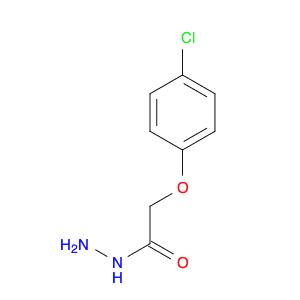
:2-(4-chlorophenoxy)acetohydrazide
Description:
2-(4-Chlorophenoxy)acetohydrazide is an organic compound characterized by its hydrazide functional group and a chlorophenoxy moiety. It typically appears as a solid and is soluble in polar solvents, reflecting its hydrophilic nature due to the presence of the hydrazide group. The compound features a 4-chlorophenoxy group, which contributes to its chemical reactivity and potential biological activity. This structure may influence its interactions in various chemical environments, making it of interest in medicinal chemistry and agricultural applications. The presence of the chlorinated aromatic ring can enhance the compound's stability and lipophilicity, potentially affecting its pharmacokinetics if used in biological systems. Additionally, 2-(4-chlorophenoxy)acetohydrazide may exhibit specific reactivity patterns typical of hydrazides, such as forming hydrazones or undergoing acylation reactions. Safety data should be consulted for handling and usage, as with any chemical substance, to ensure proper precautions are taken. Overall, this compound's unique structure positions it as a candidate for further research in various chemical and biological contexts.
Formula:C8H9ClN2O2
InChI:InChI=1/C8H9ClN2O2/c9-6-1-3-7(4-2-6)13-5-8(12)11-10/h1-4H,5,10H2,(H,11,12)
SMILES:c1cc(ccc1Cl)OCC(=NN)O
Synonyms:- (4-Chloro-phenoxy)-acetic acid hydrazide
- Acetic Acid, 2-(4-Chlorophenoxy)-, Hydrazide
Sort by
Purity (%)
0
100
|
0
|
50
|
90
|
95
|
100
Found 4 products.
Acetic acid,2-(4-chlorophenoxy)-, hydrazide
CAS:Formula:C8H9ClN2O2Purity:97%Color and Shape:SolidMolecular weight:200.62232-(4-Chlorophenoxy)acetohydrazide
CAS:2-(4-Chlorophenoxy)acetohydrazideFormula:C8H9ClN2O2Purity:≥95%Color and Shape:SolidMolecular weight:200.62g/mol2-(4-Chlorophenoxy)acetohydrazide
CAS:Formula:C8H9ClN2O2Purity:97%Color and Shape:White crystalline powderMolecular weight:200.622-(4-Chlorophenoxy)acetohydrazide
CAS:2-(4-Chlorophenoxy)acetohydrazide is a reactive compound that has been shown to have antibacterial activity in vitro. It is thought to inhibit bacterial protein synthesis by binding to the ribosome and preventing the formation of peptide bonds. 2-(4-Chlorophenoxy)acetohydrazide has also been shown to be cytotoxic in vitro, with a focus on S. aureus, as well as inhibiting the production of necrosis factor-α (NTF-α). The mechanism of action for this compound is not yet clear, but it may bind to DNA, RNA or proteins in order to inhibit cell division. This compound may also form covalent adducts with nucleic acids or proteins and prevent transcription or translation of genetic information.
Formula:C8H9ClN2O2Purity:Min. 95%Molecular weight:200.62 g/molRef: 3D-FC53986
Discontinued product