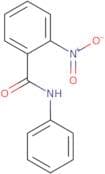
CAS 2385-27-5
:Benzamide,2-nitro-N-phenyl-
Description:
Benzamide, 2-nitro-N-phenyl- is an organic compound characterized by the presence of both a benzamide and a nitro group attached to a phenyl ring. Its molecular structure features a benzene ring bonded to an amide functional group (–C(=O)NH2) and a nitro group (–NO2) positioned at the ortho position relative to the amide. This compound is typically a solid at room temperature and may exhibit a yellowish color. It is known for its potential applications in organic synthesis and as an intermediate in the production of various pharmaceuticals and agrochemicals. The presence of the nitro group can influence the compound's reactivity and polarity, making it useful in various chemical reactions, including electrophilic aromatic substitution. Additionally, benzamide derivatives often exhibit interesting biological activities, which can be explored in medicinal chemistry. Safety data should be consulted for handling and storage, as nitro compounds can be sensitive and may pose health risks.
Formula:C13H10N2O3
Synonyms:- Benzanilide,2-nitro- (6CI,7CI,8CI)
- 2-Nitro-N-phenylbenzamide
- 2-Nitrobenzanilide
- N-Phenyl-2-nitrobenzamide
- o-Nitro-N-phenylbenzamide
- o-Nitrobenzanilide
Sort by
Purity (%)
0
100
|
0
|
50
|
90
|
95
|
100
Found 1 products.
2-Nitrobenzanilide
CAS:2-Nitrobenzanilide is a synthetic nitro compound that has been used as a reagent in organic synthesis. It is a colorless or pale yellow solid with a melting point of -14°C. It can be dissolved in benzene, chloroform, acetone and ether, but not in water. 2-Nitrobenzanilide can react with acridones to produce nitrosamines, which are carcinogenic compounds. The reaction rate for this reaction depends on the solvent used and the pH of the solution. Acridones are an alkaloid from plants of the genus Acridium. They have also been synthesized from anilines and potassium t-butoxide in sulphates or chloride media. 2-Nitrobenzanilide is one of the isomeric products when acridone reacts with chlorine at elevated temperatures. Synthesis takes place by heating acridone with potassium t-butoxide and sulphuric acid or hydroFormula:C13H10N2O3Purity:Min. 95%Color and Shape:PowderMolecular weight:242.23 g/mol