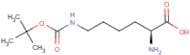
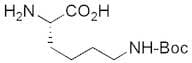
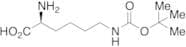
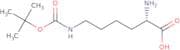
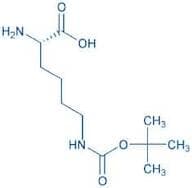
CAS 2418-95-3
:N-epsilon-(tert-Butoxycarbonyl)-L-lysine
Description:
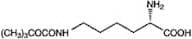
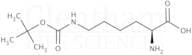
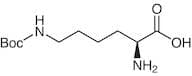
N-epsilon-(tert-Butoxycarbonyl)-L-lysine, commonly referred to as Boc-Lysine, is a derivative of the amino acid lysine, characterized by the presence of a tert-butoxycarbonyl (Boc) protecting group on the epsilon amino group of the lysine side chain. This modification enhances the stability of the amino acid during chemical reactions, particularly in peptide synthesis, by preventing unwanted reactions at the amino group. Boc-Lysine is typically a white to off-white crystalline solid, soluble in organic solvents such as dichloromethane and dimethylformamide, but less soluble in water. The compound is widely used in organic synthesis and biochemistry, particularly in the preparation of peptides and proteins, due to its ability to facilitate selective deprotection under mild acidic conditions. Its molecular structure includes a primary amine, a carboxylic acid, and a hydrophobic tert-butyl group, which influences its reactivity and solubility. As with many amino acid derivatives, it is important to handle Boc-Lysine with care, following appropriate safety protocols in a laboratory setting.
Formula:C11H22N2O4
InChI:InChI=1/C11H22N2O4/c1-11(2,3)17-10(16)8(13)6-4-5-7(12)9(14)15/h7-8H,4-6,12-13H2,1-3H3,(H,14,15)/t7-,8?/m0/s1
SMILES:CC(C)(C)OC(=O)C(CCC[C@@H](C(=O)O)N)N
Synonyms:- N6-Boc-L-lysine
- Ne-Boc-L-Lysine
- H-Lys(Boc)-OH
Sort by
Purity (%)
0
100
|
0
|
50
|
90
|
95
|
100
Found 12 products.
N(ε)-Boc-L-lysine, 97%
CAS:It is used as therapy to treat recurrent herpes simplex infections. This Thermo Scientific Chemicals brand product was originally part of the Alfa Aesar product portfolio. Some documentation and label information may refer to the legacy brand. The original Alfa Aesar product / item code or SKU referFormula:C11H22N2O4Purity:97%Color and Shape:Powder, WhiteMolecular weight:246.31N6-(tert-Butoxycarbonyl)-L-lysine
CAS:Formula:C11H22N2O4Purity:98%Color and Shape:SolidMolecular weight:246.3034Nε-(tert-Butoxycarbonyl)-L-lysine
CAS:Formula:C11H22N2O4Purity:>97.0%(T)Color and Shape:White to Almost white powder to crystalMolecular weight:246.31(2S)-2-Amino-6-(tert-butoxycarbonylamino)hexanoic acid
CAS:(2S)-2-Amino-6-(tert-butoxycarbonylamino)hexanoic acidFormula:C11H22N2O4Purity:98%Color and Shape: white powderMolecular weight:246.30g/molLys(Boc)
CAS:Formula:C11H22N2O4Purity:97%Color and Shape:Solid, Crystalline PowderMolecular weight:246.307BOC-L-Lysine extrapure, 98%
CAS:Formula:C11H22N2O4Purity:min. 98%Color and Shape:White, Crystalline powderMolecular weight:246.30Nε-Boc-L-lysine
CAS:Controlled ProductApplications Nε-Boc-D-lysine is an N-Boc-protected form of L-Lysine (L468895). L-Lysine is an essential amino acid for humans, with a suggested intake of 5-8 grams per day. L-Lysine can be found in a variety of food, such as eggs and quinoa, but is also mass produced by microbial fermentation. L-Lysine is also used as therapy to treat recurrent herpes simplex infections.
References Anastassiadis, S.: Biotechnology, 1, 11 (2007); Civitelli, R., et al.: Nutrition, 8, 400 (1991); Griffith, R., et al.: Dermatology, 175, 183 (1987)Formula:C11H22N2O4Color and Shape:NeatMolecular weight:246.31H-Lys(Boc)-OH
CAS:H-Lys(Boc)-OH is an ε-amino-protected lysine that plays a pivotal role in solution phase peptide synthesis. Strategically protected at the ε-amino group, it allows controlled peptide assembly, and it serves as intermediate for synthesizing β-peptides. The bulky Boc (tert-butyloxycarbonyl) group shields its epsilon amine (NH2) group, acting as a protective measure to prevent unwanted side reactions.Formula:C11H22N2O4Color and Shape:White PowderMolecular weight:246.3 g/molH-Lys(Boc)-OH
CAS:Bachem ID: 4000211.
Formula:C11H22N2O4Purity:> 99%Color and Shape:WhiteMolecular weight:246.31