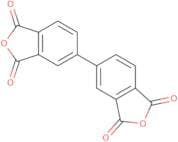
CAS 2420-87-3
:3,3′,4,4′-Biphenyltetracarboxylic dianhydride
Description:
3,3′,4,4′-Biphenyltetracarboxylic dianhydride, with the CAS number 2420-87-3, is a chemical compound known for its role as a high-performance polymer precursor. This dianhydride features two biphenyl units connected by four carboxylic acid groups that have been converted into anhydride forms, resulting in a rigid and planar structure. It is characterized by its high thermal stability, excellent mechanical properties, and resistance to solvents and chemicals, making it suitable for applications in advanced materials, particularly in the production of polyimides. The compound typically exhibits a high melting point and low solubility in common organic solvents, which can complicate processing but also contributes to its robustness in end-use applications. Additionally, it can undergo polymerization reactions to form thermosetting resins, which are utilized in electronics, aerospace, and other high-tech industries. Overall, 3,3′,4,4′-Biphenyltetracarboxylic dianhydride is valued for its unique structural properties and versatility in material science.
Formula:C16H6O6
InChI:InChI=1S/C16H6O6/c17-13-9-3-1-7(5-11(9)15(19)21-13)8-2-4-10-12(6-8)16(20)22-14(10)18/h1-6H
InChI key:InChIKey=WKDNYTOXBCRNPV-UHFFFAOYSA-N
SMILES:O=C1C=2C(C(=O)O1)=CC=C(C2)C=3C=C4C(=CC3)C(=O)OC4=O
Synonyms:- 1,1′-Biphenyl-3,3′,4,4′-tetracarboxylic acid dianhydride
- 1,1′-Biphenyl-3,3′,4,4′-tetracarboxylic dianhydride
- 2,3,3',4-Biphenyl-tetracarboxylic acid dianhydride
- 3,3',4,4'-Biphenyl tetracarboxylic dianhydride
- 3,3',4,4'-Biphenyltetracarboxylic Acid Dianhydride
- 3,3',4,4'-Biphenyltetracarboxylic Dianhydride
- 3,3',4,4'-Biphenyltetracarboxylic dianhydride (s-BPDA)
- 3,3',4,4'-Biphenyltetracarboxylic dianhydride(BPDA)
- 3,3'4,4'-Biphenyl tetracarboxylic acid dianhydride
- 3,3'4,4'-Biphenyl tetracarboxylic acid dianhydride(s-BPDA)
- 3,3,4,4-Biphenyltetracarboxylic Dianhydride
- 3,3′,4,4′-Biphenyltetracarbocylic dianhydride
- 3,3′,4,4′-Biphenyltetracarboxylic 3,4:3′,4′-dianhydride
- 3,3′,4,4′-Biphenyltetracarboxylic acid anhydride
- 3,3′,4,4′-Biphenyltetracarboxylic acid dianhydride
- 3,3′,4,4′-Biphenyltetracarboxylic anhydride
- 3,3′,4,4′-Diphenyltetracarboxylic dianhydride
- 3,3′,5,5′-Biphenyltetracarboxylic 3,5:3′,5′-dianhydride
- 3,4'3'4'-Biphenyl-Tetracarboxylic Acid Dianhydride
- 3,4,3′,4′-Biphenyltetracarboxylic acid dianhydride
- 3,4,3′,4′-Biphenyltetracarboxylic dianhydride
- 4,4-Biphthalic anhydride
- 4,4′-Biphthalic dianhydride
- 5,10,4-Buta[1,3]Diene[1,2,4]Triyl-2,7-Benzodioxecine-1,3,6,8-Tetrone
- 5,5'-Bi-2-Benzofuran-1,1',3,3'-Tetrone
- B 1326
- Biphthalicanhydride
- Bpda
- Diphenyl-3,3',4,4'-tetracarboxylic Dianhydride
- S-Bpda
- [1,1′-Biphenyl]-3,3′,4,4′-tetracarboxylic 3,4:3′,4′-dianhydride
- [5,5′-Biisobenzofuran]-1,1′,3,3′-tetrone
- See more synonyms
Sort by
Purity (%)
0
100
|
0
|
50
|
90
|
95
|
100
Found 6 products.
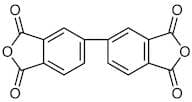
4,4'-Biphthalic Anhydride (purified by sublimation)
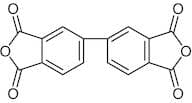
CAS:Formula:C16H6O6Purity:>98.0%(HPLC)Color and Shape:White to Light yellow powder to crystalMolecular weight:294.224,4'-Biphthalic Anhydride
CAS:Formula:C16H6O6Purity:>98.0%(T)Color and Shape:White to Green to Brown powder to crystalMolecular weight:294.223,3,4,4-Biphenyltetracarboxylic Dianhydride
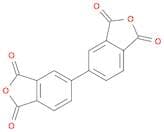
CAS:Formula:C16H6O6Purity:96%Color and Shape:SolidMolecular weight:294.2152[5,5'-Biisobenzofuran]-1,1',3,3'-tetraone
CAS:[5,5'-Biisobenzofuran]-1,1',3,3'-tetraoneFormula:C16H6O6Purity:97%Color and Shape: white powderMolecular weight:294.22g/mol3,3′,4,4′-Biphenyltetracarboxylic dianhydride
CAS:Formula:C16H6O6Purity:96%Color and Shape:Solid, Tan powderMolecular weight:294.2184,4'-Biphthalic anhydride
CAS:4,4'-Biphthalic anhydride is a dianhydride that can be reacted with amines to form amides. It is a colorless, water-soluble solid that has been used in the production of polyimides and other polymers. 4,4'-Biphthalic anhydride reacts with hydrochloric acid to form a molecule of water vapor and the corresponding salt. This compound also reacts with hydroxyl groups to produce carbonyl groups. 4,4'-Biphthalic anhydride has a thermal expansion coefficient of 7 x 10^-5 K^-1, which is greater than that of most organic compounds. This high expansion coefficient means that it can be used in applications where low thermal expansion coefficients are needed.
Formula:C16H6O6Purity:Min. 95%Molecular weight:294.22 g/mol


![[5,5'-Biisobenzofuran]-1,1',3,3'-tetraone](/_next/image/?url=https%3A%2Fstatic.cymitquimica.com%2Fproducts%2F54%2Fthumb%2FOR912402.jpg&w=3840&q=75)