


CAS 243145-83-7
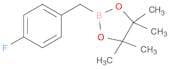
:4-Fluorobenzylboronic acid pinacol ester
Description:
4-Fluorobenzylboronic acid pinacol ester is an organoboron compound characterized by the presence of a boronic acid functional group and a fluorobenzyl moiety. It typically appears as a white to off-white solid and is soluble in organic solvents such as dichloromethane and ethanol. The compound is notable for its reactivity, particularly in Suzuki-Miyaura cross-coupling reactions, where it serves as a versatile building block in organic synthesis, especially in the formation of biaryl compounds. The presence of the fluorine atom can influence the electronic properties of the molecule, enhancing its reactivity and selectivity in various chemical transformations. Additionally, the pinacol ester group provides stability to the boronic acid functionality, making it easier to handle and store. This compound is of interest in medicinal chemistry and materials science due to its potential applications in drug development and the synthesis of functionalized polymers. As with many organoboron compounds, proper handling and storage are essential due to their sensitivity to moisture and air.
Formula:C13H18BFO2
Synonyms:- 2-(4-Fluorobenzyl)-4,4,5,5-tetramethyl-1,3,2-dioxaborolane
Sort by
Purity (%)
0
100
|
0
|
50
|
90
|
95
|
100
Found 4 products.
2-(4-Fluorobenzyl)-4,4,5,5-tetramethyl-1,3,2-dioxaborolane
CAS:Formula:C13H18BFO2Purity:95%Color and Shape:SolidMolecular weight:236.09024-Fluorobenzylboronic acid, pinacol ester
CAS:4-Fluorobenzylboronic acid, pinacol esterFormula:C13H18BFO2Purity:97%Color and Shape: colourless liquidMolecular weight:236.09g/mol2-(4-Fluorobenzyl)-4,4,5,5-tetramethyl-1,3,2-dioxaborolane
CAS:Formula:C13H18BFO2Purity:95%Color and Shape:LiquidMolecular weight:236.092-[(4-fluorophenyl)methyl]-4,4,5,5-tetramethyl-1,3,2-dioxabo
CAS:2-[(4-fluorophenyl)methyl]-4,4,5,5-tetramethyl-1,3,2-dioxaborolane is a chemical compound with the molecular formula C10H14FNO. It can be synthesized by Suzuki cross-coupling of 4-fluorobenzaldehyde and resorcinol. This process is catalyzed by palladium acetate and copper iodide in an organic solvent such as ethanol. The reaction is followed by acidification to remove the catalyst and the product is extracted with dichloromethane. 2-[(4-fluorophenyl)methyl]-4,4,5,5-tetramethyl-1,3,2-dioxaborolane has been shown to have affinity for Grp94. This affinity may be due to its ability to modify proteins in cancer cells or its regioselectivity due to its susceptibility to hydrolysis at theFormula:C13H18BFO2Purity:Min. 95%Molecular weight:236.09 g/mol



![2-[(4-fluorophenyl)methyl]-4,4,5,5-tetramethyl-1,3,2-dioxabo](/_next/image/?url=https%3A%2Fstatic.cymitquimica.com%2Fproducts%2F3D%2Fthumb%2FFF105786.jpg&w=3840&q=75)
