CAS 245321-46-4
:2-Pyrimidinecarbonitrile,4-amino-
Description:
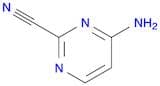
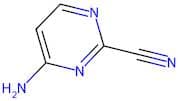
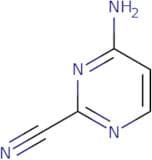
2-Pyrimidinecarbonitrile, 4-amino- is a heterocyclic organic compound characterized by its pyrimidine ring structure, which contains nitrogen atoms in the ring. The presence of a cyano group (-C≡N) at the 2-position and an amino group (-NH2) at the 4-position contributes to its reactivity and potential applications in various chemical reactions. This compound is typically a solid at room temperature and may exhibit polar characteristics due to the functional groups present. It is often used in medicinal chemistry and as an intermediate in the synthesis of pharmaceuticals, agrochemicals, and other organic compounds. The compound's properties, such as solubility and stability, can vary depending on the solvent and environmental conditions. Safety data should be consulted for handling and storage, as with any chemical substance, to ensure proper precautions are taken. Overall, 2-Pyrimidinecarbonitrile, 4-amino- is of interest in research and development due to its unique structural features and potential utility in various applications.
Formula:C5H4N4
Synonyms:- 2-Pyrimidinecarbonitrile, 4-amino- (9CI)
- 4-Aminopyrimidine-2-Carbonitrile
Sort by
Purity (%)
0
100
|
0
|
50
|
90
|
95
|
100
Found 4 products.
2-Pyrimidinecarbonitrile, 4-amino- (9CI)
CAS:Formula:C5H4N4Purity:95%Color and Shape:SolidMolecular weight:120.11214-Aminopyrimidine-2-carbonitrile
CAS:4-Aminopyrimidine-2-carbonitrilePurity:≥95%Color and Shape:PowderMolecular weight:120.11g/mol4-Aminopyrimidine-2-carbonitrile
CAS:4-Aminopyrimidine-2-carbonitrile is an organic compound that is structurally related to pyrimidine derivatives. It is a drug candidate for the treatment of tuberculosis (TB) and other multidrug resistant bacteria. 4-Aminopyrimidine-2-carbonitrile has been shown to be more potent than formamide and triethyl orthoformate, but less potent than aminopyrazole. The mechanism of action of 4-aminopyrimidine-2-carbonitrile is not well understood, but it may involve an epoxide intermediate that generates reactive oxygen species, which causes necrosis in the bacterial cell. The drug also exhibits some activity against tumour necrosis factor alpha (TNFα).
Purity:Min. 95%