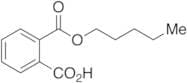
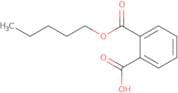
CAS 24539-56-8
:Mono-n-pentyl phthalate
Description:
Mono-n-pentyl phthalate (CAS 24539-56-8) is an ester derived from phthalic acid and n-pentanol. It is characterized by its use as a plasticizer, which enhances the flexibility and workability of polymers, particularly in the production of flexible PVC. This compound typically appears as a colorless to pale yellow liquid with a low volatility and moderate viscosity. It is soluble in organic solvents but has limited solubility in water, which is a common trait among phthalate esters. Mono-n-pentyl phthalate is known for its relatively low toxicity compared to other phthalates, although it is still subject to regulatory scrutiny due to potential environmental and health concerns associated with phthalate exposure. Its applications extend beyond plastics to include use in coatings, adhesives, and sealants. As with many phthalates, ongoing research is focused on understanding its environmental impact and potential effects on human health, particularly regarding endocrine disruption and reproductive toxicity.
Formula:C13H16O4
InChI:InChI=1S/C13H16O4/c1-2-3-6-9-17-13(16)11-8-5-4-7-10(11)12(14)15/h4-5,7-8H,2-3,6,9H2,1H3,(H,14,15)
InChI key:InChIKey=FPGPRAKRYDSZAW-UHFFFAOYSA-N
SMILES:C(OCCCCC)(=O)C1=C(C(O)=O)C=CC=C1
Synonyms:- 1,2-Benzenedicarboxylic Acid, Monopentyl Ester
- 1,2-Benzenedicarboxylic acid, 1-pentyl ester
- Mono-n-pentyl phthalate
- Monoamyl phthalate
- Monopentyl phthalate
- Phthalic acid, monopentyl ester
- Phthalic acid, pentyl ester
- 2-[(Pentyloxy)carbonyl]benzoic acid
Sort by
Purity (%)
0
100
|
0
|
50
|
90
|
95
|
100
Found 3 products.
2-Methyl-d3-propionitrile-3,3,3-d3 (isobutyronitrile)
CAS:Formula:CD3CH(CD3)CNPurity:99 atom % DColor and Shape:Colorless LiquidMolecular weight:75.09551Monopentyl Phthalate
CAS:Applications A metabolite of Di-n-pentyl phthalate (DPP), used mainly as a plasticizer in nitrocellulose.
References Schmid, P., et al.: Xenobiotica, 1985, 15, 251 (1985), Nativelle, C., et al.: Food Chem. Toxicol., 37, 905 (1999), Howdeshell, K., et al.: Toxicol. Sci., 105, 153 (2008),Formula:C13H16O4Color and Shape:White To Off-WhiteMolecular weight:236.26Monopentyl phthalate
CAS:Monopentyl phthalate (MPP) is a plasticizer that is used in the production of polyvinyl chloride (PVC) plastics, such as vinyl flooring and furniture. MPP is also used in the manufacture of paints and adhesives. It is found in many consumer products, such as children's toys, shower curtains, and garden hoses. MPP has been shown to have endocrine disrupting effects on animals at high doses. Endometriosis has been linked to increased levels of MPP metabolites in urine samples from women. The toxicological studies on rats showed that chronic exposure to MPP causes testicular atrophy and decreases sperm production by inhibiting the activity of testosterone-synthesizing cells called Leydig cells. Rats exposed to high doses of MPP had decreased levels of ATP in their testes. The effect was observed even at low doses that were comparable with human exposures from environmental sources. Monopentyl phthalate can beFormula:C13H16O4Purity:Min. 95%Molecular weight:236.26 g/mol