CAS 245443-52-1
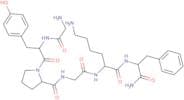
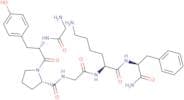
:L-Phenylalaninamide,glycyl-L-tyrosyl-L-prolylglycyl-L-lysyl-
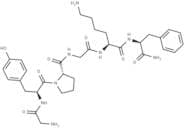
- H-Gly-Tyr-Pro-Gly-Lys-Phe-Nh2
PAR-4 (1-6) amide (mouse)
CAS:Protease-activated receptor-4 activating peptide derived from murine PAR-4. GYPGKF-amide was able to cause rat platelet aggregation with an EC₅₀ value of 40 µM. Its effect on leucocyte rolling and adherence points at a role of PAR-4 in mediating proinflammatory processes.Formula:C33H46N8O7Purity:98.5%Color and Shape:Whitish PowderMolecular weight:666.78H-Gly-Tyr-Pro-Gly-Lys-Phe-NH2
CAS:This is a synthetic peptide that mimics the endogenous human epidermal growth factor (EGF) and binds to the toll-like receptor. It has been shown to stimulate physiological function in experimental models of bowel disease and cardiac disease, as well as cancer tissues. The peptide also binds to the guanine nucleotide-binding protein, polymerase chain reaction, and inflammatory bowel disease genes. In vivo studies have confirmed that this peptide enhances the production of EGF in maternal blood and stimulates squamous carcinoma growth in an animal model.Formula:C33H46N8O7Purity:Min. 95%Molecular weight:666.78 g/molPAR-4 Agonist (Mouse)
CAS:Thrombin is the main effector of the coagulation cascade- it is a serine protease. Thrombin binds to active protease activated receptor (PAR) which belongs to a subfamily of G-protein coupled receptors (GPCR). Thrombin activation of mouse PAR-4 reveals an amino terminus sequence of GYPGKF. This is the natural ligand for PAR-4. GYPGKF binds internally to the receptor and leads to signalling activation. Identification of GYPGKF as a PAR-4 agonist has allowed better understand of the function of PAR. Addition of GYPGKF to PAR-4 expressing cell lines achieved 55% of the maximal response of thrombin. GYPGKF can provide understanding of PAR-4 and a template for more potent agonists.
Formula:C33H46N8O7Color and Shape:PowderMolecular weight:666.3 g/molPAR-4 (1-6) amide (mouse) trifluoroacetate salt
CAS:PAR-4 (1-6) amide (mouse) trifluoroacetate salt H-Gly-Tyr-Pro-Gly-Lys-Phe-NH2 trifluoroacetate salt is a guanine nucleotide binding protein that belongs to the PAR family of proteins. It is expressed in wild type mice and binds to the cytosolic calcium, which regulates polymerase chain reaction. PAR-4 (1-6) amide (mouse) trifluoroacetate salt H-Gly-Tyr-Pro-Gly-Lys-Phe NH2 trifluoroacetate salt can be used as a potential drug target for epidermal growth factor. It has been shown to activate transcription polymerase chain and transcriptase polymerase chain during transcriptional regulation of messenger RNA.
Formula:C33H46N8O7Purity:Min. 95%Molecular weight:666.77 g/molProtease-Activated Receptor-4
CAS:Protease-Activated Receptor-4 (PAR4) is a proteinase-activated receptor-4 agonist used in antiplatelet therapy.Formula:C33H46N8O7Purity:98%Color and Shape:SolidMolecular weight:666.77PAR-4 (1-6) amide (mouse)
CAS:Custom research peptide; min purity 95%. For different specs please use the Peptide Quote Tool
Formula:C33H46N8O7Molecular weight:666.78 g/mol