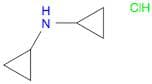
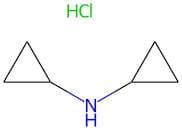
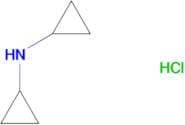
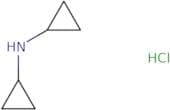
CAS 246257-69-2
:Dicyclopropylamine hydrochloride
- N-cyclopropylcyclopropanamine hydrochloride
- dicyclopropylamine HCl
- Cyclopropanamine, N-cyclopropyl-, hydrochloride (1:1)
- DicycloprophylaMine HCl
- DICYCLOPROPYLAMINE HYDROCHLORIDE
Dicyclopropylamine hydrochloride
CAS:Dicyclopropylamine hydrochlorideFormula:C6H11N·ClHPurity:95%Color and Shape:Light Yellow SolidMolecular weight:133.62g/molDicyclopropylamine hydrochloride
CAS:Formula:C6H12ClNPurity:97%Color and Shape:SolidMolecular weight:133.62Dicyclopropylamine hydrochloride
CAS:Dicyclopropylamine hydrochloride is a tyrosine kinase inhibitor that blocks the activity of jak2. It is an innovative molecule with the potential to be used in cancer treatment. Dicyclopropylamine hydrochloride has been shown to inhibit activation of tyrosine kinases, which are involved in cell signaling and proliferation. Dicyclopropylamine hydrochloride also has anti-inflammatory properties, which may be due to its ability to inhibit prostaglandin synthesis. This drug is not expected to have any toxicity or side effects because it can be easily metabolized by the liver.br>br> Dicyclopropylamine hydrochloride is a white solid with a melting point of 175°C. It has no detectable odor, and it is soluble in water and ethanol. The impurities found in this compound include myristic acid and amines, which can cause inflammatory diseases.br>br> D
Formula:C6H11N•HClPurity:Min. 95%Color and Shape:PowderMolecular weight:133.62 g/molRef: 3D-FD141573
Discontinued product