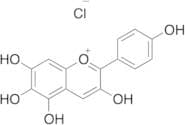
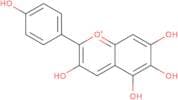
CAS 25041-66-1
:Aurantinidin
Description:
Aurantinidin is a natural pigment belonging to the class of anthocyanins, which are water-soluble vacuolar pigments responsible for the red, purple, and blue colors in many plants. It is primarily derived from various plant sources, particularly in the family of flowering plants known as the Asteraceae. Aurantinidin exhibits strong antioxidant properties, which contribute to its potential health benefits, including anti-inflammatory and anti-cancer effects. The compound is characterized by its ability to absorb light in the visible spectrum, which is crucial for its role in attracting pollinators and seed dispersers. In terms of chemical structure, aurantinidin contains multiple hydroxyl groups, contributing to its solubility and reactivity. Its stability can be influenced by factors such as pH, temperature, and the presence of metal ions. Due to its vibrant color and beneficial properties, aurantinidin is of interest in food science, cosmetics, and pharmaceuticals, where it may be used as a natural colorant or health supplement.
Formula:C15H11O6·Cl
InChI:InChI=1S/C15H10O6.ClH/c16-8-3-1-7(2-4-8)15-11(18)5-9-12(21-15)6-10(17)14(20)13(9)19;/h1-6H,(H4-,16,17,18,19,20);1H
InChI key:InChIKey=ISJQFQSYBIWCHP-UHFFFAOYSA-N
SMILES:OC=1C2=C([O+]=C(C(O)=C2)C3=CC=C(O)C=C3)C=C(O)C1O.[Cl-]
Synonyms:- 1-Benzopyrylium, 3,5,6,7-tetrahydroxy-2-(4-hydroxyphenyl)-, chloride
- 1-Benzopyrylium, 3,5,6,7-tetrahydroxy-2-(4-hydroxyphenyl)-, chloride (1:1)
- 25041-66-1
- 6-Hydroxypelargonidin
- 6-Hydroxypelargonidin chloride
- Aurantinidin
- Aurantinidol chloride
- Flavylium, 3,4′,5,6,7-pentahydroxy-, chloride
Sort by
Purity (%)
0
100
|
0
|
50
|
90
|
95
|
100
Found 2 products.
Aurantinidin Chloride
CAS:Controlled ProductFormula:C15H11ClO6Color and Shape:NeatMolecular weight:322.7Aurantinidin chloride
CAS:Aurantinidin chloride is a molecule that has been shown to inhibit the growth of prostate cancer cells in vitro. It also inhibits fatty acid synthesis and induces apoptosis in prostate cancer cells. Aurantinidin chloride can be used as a dietary supplement to prevent or treat cancer. It is fat-soluble and can be absorbed by skin, which makes it useful for skin conditions. Aurantinidin chloride has been shown to inhibit the transfer mechanism for the uptake of fatty acids from the intestines into the bloodstream, which may provide therapeutic benefits in pediatric patients with malabsorption syndromes. Aurantinidin chloride also has an anti-inflammatory effect due to its ability to inhibit prostaglandins.Formula:C15H11O6Purity:Min. 95%Molecular weight:287.24 g/mol