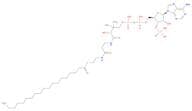
CAS 25045-61-8
:Coenzyme A,S-nonadecanoate
Description:
Coenzyme A, S-nonadecanoate, with the CAS number 25045-61-8, is a derivative of coenzyme A, which plays a crucial role in various biochemical processes, particularly in the metabolism of fatty acids and the synthesis of acetyl-CoA. This compound features a long-chain fatty acid moiety, specifically nonadecanoate, which contributes to its hydrophobic characteristics. Coenzyme A itself is essential for the activation and transport of acyl groups, facilitating their entry into metabolic pathways. The presence of the nonadecanoate chain enhances its lipid solubility, making it relevant in cellular membranes and lipid metabolism. In terms of structure, it contains a pantothenic acid component, a beta-mercaptoethylamine unit, and an adenosine moiety, which are integral to its function. The compound is typically involved in enzymatic reactions, serving as a cofactor for acyltransferases and other enzymes. Its role in energy metabolism and biosynthetic pathways underscores its importance in cellular physiology and biochemistry.
Formula:C40H72N7O17P3S
Synonyms:- Nonadecanethioicacid, S-ester with coenzyme A (8CI)
- Nonadecanoyl coenzyme A
- Nonadecanoyl-CoA
Sort by
Purity (%)
0
100
|
0
|
50
|
90
|
95
|
100
Found 3 products.
Nonadecanoyl Coenzyme A, free acid
CAS:Formula:C40H72N7O17P3SPurity:>95%Color and Shape:SolidMolecular weight:1048.03Nonadecanoyl coenzyme A
CAS:<p>Nonadecanoyl coenzyme A is a fatty acid that is produced by the bovine liver and has been shown to have anabolic effects. Nonadecanoyl CoA is involved in the synthesis of various lipids, such as phospholipids, cholesterol, and glycolipids. It also plays a role in biosynthesis of fatty acids and in regulating ATP production. Nonadecanoyl CoA is synthesized from acetate by the enzyme acetyl-CoA carboxylase (ACC). ACC catalyzes the conversion of acetyl-CoA to malonyl-CoA, which can then be used for fatty acid synthesis. Nonadecanoyl CoA has been found to play an important role in regulating mitochondrial function through its ability to activate long-chain acyl-CoAs desaturase (LCAD). LCAD converts long-chain acyl-CoAs into their corresponding dicarboxylic acids.</p>Formula:C40H72N7O17P3SPurity:Min. 95%Molecular weight:1,048.02 g/mol