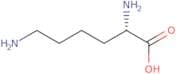
CAS 25104-18-1
:Poly(L-lysine)
Description:
Poly(L-lysine) is a synthetic polypeptide composed of repeating units of the amino acid L-lysine. It is characterized by its cationic nature due to the presence of amino groups in its structure, which can interact with negatively charged molecules, making it useful in various applications such as drug delivery, gene therapy, and as a coating material. The polymer exhibits good biocompatibility and biodegradability, which are essential for biomedical applications. Poly(L-lysine) can exist in different forms, including linear and branched structures, and its molecular weight can vary significantly, influencing its physical and chemical properties. The polymer is soluble in water and can form stable complexes with nucleic acids, enhancing its utility in gene transfection. Additionally, Poly(L-lysine) can be modified chemically to improve its functionality, such as increasing its hydrophobicity or introducing targeting moieties. Overall, its versatility and favorable properties make Poly(L-lysine) a valuable material in both research and clinical settings.
Formula:(C6H14N2O2)x
InChI:InChI=1S/C6H14N2O2/c7-4-2-1-3-5(8)6(9)10/h5H,1-4,7-8H2,(H,9,10)/t5-/m0/s1
InChI key:InChIKey=KDXKERNSBIXSRK-YFKPBYRVSA-N
SMILES:[C@H](CCCCN)(C(O)=O)N
Synonyms:- <span class="text-smallcaps">L</span>-Lysine polymer
- <span class="text-smallcaps">L</span>-Lysine, homopolymer
- Everguard PL
- L-Lysine, homopolymer
- Lysine homopolymer
- Lysine homopolymer, L-
- Lysine polymer
- Lysine, <span class="text-smallcaps">L</span>-, peptides
- Poly(<span class="text-smallcaps">L</span>-lysine)
- Poly(L-lysine)
- Polylysine
- See more synonyms
Sort by
Purity (%)
0
100
|
0
|
50
|
90
|
95
|
100
Found 5 products.
Poly(L-lysine)
CAS:Poly(L-lysine) is a homopolymer of lysine that functions as an adhesion factor to enhance cellular adhesion, applicable for DNA and protein delivery.Color and Shape:White To Light Yellow PowderLysine homopolymer
CAS:Lysine homopolymer is a synthetic polymer that is used to promote pluripotency in cells. It has been shown to be effective when combined with l-lysine, which promotes cell transformation and cellular physiology. Lysine homopolymer has also been shown to inhibit the synthesis of ubiquitin ligases, which are enzymes involved in the degradation of proteins. Lysine homopolymer can also be used as a chemical probe for cancer tissues due to its ability to bind to lysine residues on proteins, which are not present on normal tissue or healthy cells.Formula:(C6H14N2O2)xPurity:Min. 95%Color and Shape:White Powder