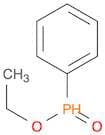
CAS 2511-09-3
:Ethyl phenylphosphinate
Description:
Ethyl phenylphosphinate is an organophosphorus compound characterized by the presence of a phosphinate functional group attached to an ethyl group and a phenyl group. Its molecular structure features a phosphorus atom bonded to an ethyl group (–OCH2CH3) and a phenyl group (–C6H5), along with an oxygen atom that is part of the phosphinate group. This compound is typically a colorless to pale yellow liquid with a relatively low viscosity. Ethyl phenylphosphinate is known for its applications in various fields, including as a flame retardant and in the synthesis of other phosphorus-containing compounds. It exhibits moderate stability under normal conditions but can hydrolyze in the presence of strong acids or bases. The compound is also of interest in the study of phosphorus chemistry due to its unique reactivity and potential applications in materials science and organic synthesis. Safety precautions should be taken when handling this substance, as it may pose health risks if ingested or inhaled.
Formula:C8H11O2P
InChI:InChI=1S/C8H11O2P/c1-2-10-11(9)8-6-4-3-5-7-8/h3-7,11H,2H2,1H3
InChI key:InChIKey=UNUJZVUJPIOMGH-UHFFFAOYSA-N
SMILES:P(OCC)(=O)C1=CC=CC=C1
Synonyms:- Ethoxy(Oxo)Phenylphosphonium
- Ethoxyphenylphosphine oxide
- Ethyl benzenephosphinite
- Nsc 300841
- O-Ethyl phenylphosphinate
- O-Ethyl phenylphosphoinate
- Phenylphosphinic acid ethyl ester
- Phosphinic acid, P-phenyl-, ethyl ester
- Phosphinic acid, phenyl-, ethyl ester
- Ethyl phenylphosphinate
- Ethyl phenylphosphinate
Sort by
Purity (%)
0
100
|
0
|
50
|
90
|
95
|
100
Found 5 products.
Phosphinic acid, P-phenyl-, ethyl ester
CAS:Formula:C8H11O2PPurity:95%Color and Shape:LiquidMolecular weight:170.1455Ethyl phenylphosphinate
CAS:Ethyl phenylphosphinateFormula:C8H11O2PPurity:>95%Color and Shape:LiquidMolecular weight:170.15Ethyl phenylphosphinate
CAS:Ethyl phenylphosphinate is a coordination compound with an amide group. It has been shown to be effective in the treatment of Staphylococcus and Streptococcus strains, as well as other bacteria that are resistant to common antibiotics. The enantiomer of ethyl phenylphosphinate (EPP) is more potent than the racemic mixture (i.e., both enantiomers). EPP binds to chemokine receptors on the surface of cells and inhibits their activity. This prevents chemokines from binding to their receptor and activating signaling pathways that lead to inflammation, cell proliferation, and tumor growth. EPP also has anti-inflammatory properties and is used in pharmaceutical preparations for the treatment of inflammation-related diseases such as asthma.Formula:C8H11O2PPurity:Min. 95%Color and Shape:Colorless Clear LiquidMolecular weight:170.15 g/mol