CAS 25110-76-3
:5-ethyluridine
Description:
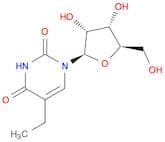
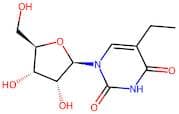
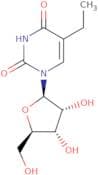
5-Ethyluridine is a nucleoside analog derived from uridine, characterized by the presence of an ethyl group at the 5-position of the pyrimidine ring. This modification can influence its biological activity and interactions with nucleic acid structures. The molecular formula of 5-ethyluridine reflects its composition of carbon, hydrogen, nitrogen, and oxygen atoms, typical of nucleosides. It is soluble in water and exhibits properties that allow it to participate in various biochemical processes, including potential roles in RNA synthesis and metabolism. The compound is of interest in research, particularly in the fields of molecular biology and medicinal chemistry, where it may serve as a tool for studying RNA function or as a potential therapeutic agent. Its CAS number, 25110-76-3, is a unique identifier that facilitates the tracking and referencing of this specific chemical substance in scientific literature and databases. Overall, 5-ethyluridine exemplifies the structural diversity of nucleosides and their importance in biological systems.
Formula:C11H16N2O6
InChI:InChI=1/C11H16N2O6/c1-2-5-3-13(11(18)12-9(5)17)10-8(16)7(15)6(4-14)19-10/h3,6-8,10,14-16H,2,4H2,1H3,(H,12,17,18)/t6-,7-,8-,10-/m1/s1
SMILES:CCc1cn([C@H]2[C@@H]([C@@H]([C@@H](CO)O2)O)O)c(=O)nc1O
Synonyms:- Uridine, 5-ethyl-
Sort by
Purity (%)
0
100
|
0
|
50
|
90
|
95
|
100
Found 4 products.
1-((2R,3R,4S,5R)-3,4-Dihydroxy-5-(hydroxymethyl)tetrahydrofuran-2-yl)-5-ethylpyrimidine-2,4(1H,3H)-dione
CAS:1-((2R,3R,4S,5R)-3,4-Dihydroxy-5-(hydroxymethyl)tetrahydrofuran-2-yl)-5-ethylpyrimidine-2,4(1H,3H)-dionePurity:97%Molecular weight:272.26g/mol5-Ethyluridine
CAS:5-Ethyluridine is a 5-Modified Pyrimidine Nucleoside.Formula:C11H16N2O6Color and Shape:SolidMolecular weight:272.25Ref: TM-TNU0122
5mgTo inquire10mgTo inquire25mgTo inquire50mgTo inquire100mgTo inquire500mgTo inquire5-Ethyluridine
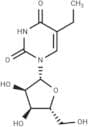
CAS:5-Ethyluridine is a modified form of uridine. The ethyl group on the 5-position of uridine has been replaced by an ethyl group. This modification inhibits the growth of bacteria, which may be due to inhibition of purine synthesis or due to conformational changes in the active site. It is not clear why this modification inhibits bacterial growth, but it does not inhibit human cell growth.Purity:Min. 95%