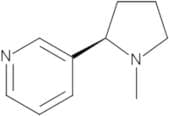
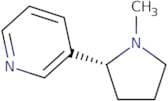
CAS 25162-00-9
:(+)-Nicotine
Description:
(+)-Nicotine, with the CAS number 25162-00-9, is a naturally occurring alkaloid primarily found in the tobacco plant, Nicotiana tabacum. It is a colorless to pale yellow liquid at room temperature and has a characteristic pungent odor. The compound is known for its stimulant effects on the central nervous system, acting as an agonist at nicotinic acetylcholine receptors. (+)-Nicotine is chiral, with the (+) designation indicating its specific optical activity, meaning it rotates plane-polarized light to the right. It has a relatively high solubility in water and is also soluble in organic solvents such as ethanol and chloroform. The substance is hygroscopic, meaning it can absorb moisture from the air. In terms of safety, nicotine is toxic in high doses, and its use is associated with addiction and various health risks, particularly when consumed through tobacco products. Its pharmacological properties have led to research into its potential therapeutic applications, including in smoking cessation therapies.
Formula:C10H14N2
InChI:InChI=1S/C10H14N2/c1-12-7-3-5-10(12)9-4-2-6-11-8-9/h2,4,6,8,10H,3,5,7H2,1H3/t10-/m1/s1
InChI key:InChIKey=SNICXCGAKADSCV-SNVBAGLBSA-N
SMILES:CN1[C@H](CCC1)C=2C=CC=NC2
Synonyms:- (+)-(R)-Nicotine
- (+)-Nicotine
- (R)-3-(1-Methylpyrrolidin-2-yl)pyridine
- 2'bH-Nicotine (8CI)
- 2′β<span class="text-smallcaps">H</span>-Nicotine
- 3-[(2R)-1-Methyl-2-pyrrolidinyl]pyridine
- 3-[(2R)-1-Methylpyrrolidin-2-yl]pyridine
- <span class="text-smallcaps">D</span>-(+)-Nicotine
- D-(+)-Nicotine
- Pseudonicotine
- Pyridine,3-(1-methyl-2-pyrrolidinyl)-, (R)-
- Pyridine, 3-[(2R)-1-methyl-2-pyrrolidinyl]-
- See more synonyms
Sort by
Purity (%)
0
100
|
0
|
50
|
90
|
95
|
100
Found 4 products.
Pyridine, 3-[(2R)-1-methyl-2-pyrrolidinyl]-
CAS:Formula:C10H14N2Purity:98%Color and Shape:SolidMolecular weight:162.2316R-(+)-Nicotine
CAS:R-(+)-nicotine is a chiral compound that binds to nicotinic receptors, which are found in the brain, autonomic ganglia and neuromuscular junctions. It has a biphasic response, with low doses stimulating the release of acetylcholine (ACh) and higher doses inhibiting ACh release. It also inhibits metabolic rate, binding to nicotinic receptors on cells of the proximal tubules in the kidney. R-(+)-nicotine is metabolized by CYP2A6 and CYP3A4 enzymes to form cotinine. The elimination half-life of nicotine is about 2 hours after intravenous administration, but ranges from 30 minutes to 12 hours for various routes of administration. Nicotine is excreted primarily in urine as metabolites cotinine and trans-3′-hydroxycotinine.
Formula:C10H14N2Purity:Min. 95 Area-%Color and Shape:Clear LiquidMolecular weight:162.23 g/mol
![Pyridine, 3-[(2R)-1-methyl-2-pyrrolidinyl]-](/_next/image/?url=https%3A%2Fstatic.cymitquimica.com%2Fproducts%2FIN%2Fthumb%2FDA002QQ1.jpg&w=3840&q=75)