CAS 2521-07-5
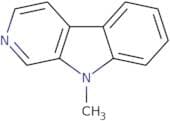
:9-methyl-9H-beta-carboline
Description:
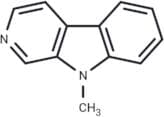
9-Methyl-9H-beta-carboline is an organic compound belonging to the beta-carboline family, which is characterized by a fused bicyclic structure containing a pyridine and an indole moiety. This compound features a methyl group at the 9-position of the beta-carboline framework, which can influence its biological activity and chemical properties. 9-Methyl-9H-beta-carboline is known for its potential neuropharmacological effects, including interactions with neurotransmitter systems, and has been studied for its role in various biological processes. It exhibits fluorescence properties, making it useful in certain analytical applications. The compound is typically soluble in organic solvents, and its stability can be affected by environmental conditions such as pH and temperature. Additionally, beta-carbolines, including 9-methyl-9H-beta-carboline, are of interest in medicinal chemistry due to their diverse pharmacological activities, including antioxidant, anti-inflammatory, and potential anticancer properties. As with many chemical substances, safety and handling precautions should be observed, as beta-carbolines can exhibit toxicity at certain concentrations.
Formula:C12H10N2
InChI:InChI=1/C12H10N2/c1-14-11-5-3-2-4-9(11)10-6-7-13-8-12(10)14/h2-8H,1H3
SMILES:Cn1c2ccccc2c2ccncc12
Synonyms:- 9H-Pyrido(3,4-b)indole, 9-methyl-
- 9-Methyl-9H-pyrido(3,4-b)indole
- 9-Methyl-Beta-Carboline
Sort by
Purity (%)
0
100
|
0
|
50
|
90
|
95
|
100
Found 6 products.
9-Methyl-9H-pyrido[3,4-b]indole
CAS:Formula:C12H10N2Purity:>98.0%(GC)(T)Color and Shape:White to Yellow to Green powder to crystalMolecular weight:182.239H-Pyrido[3,4-b]indole, 9-methyl-
CAS:Formula:C12H10N2Purity:97%Color and Shape:SolidMolecular weight:182.22129-Methyl-9H-Pyrido[3,4-b]Indole
CAS:9-Methyl-9H-Pyrido[3,4-b]IndolePurity:98%Molecular weight:182.22g/mol9-Methyl-b-carboline
CAS:9-Methyl-b-carboline is a phytochemical that belongs to the class of protonated carbon disulphide. It has been shown to inhibit monoamine oxidase and is used in some medications. 9-Methyl-b-carboline has been shown to have physiological function, including growth factor activity and epidermal growth properties. It also inhibits hydroxylase, which is an enzyme that catalyzes the stepwise oxidation of tyrosine and phenylalanine. This compound can be found in plants belonging to the families of Fabaceae, Lamiaceae, and Solanaceae. The compound has been found to act as a secondary messenger in mitochondria by transferring electrons from NADH to coenzyme Q10.Formula:C12H10N2Purity:Min. 98%Color and Shape:Off-White PowderMolecular weight:182.22 g/mol9-Methyl-β-carboline
CAS:9-Methyl-β-carboline is a cognitive enhancer with neuroprotective, neurorestorative, and anti-inflammatory properties. Its behavioral effects may be linked to hippocampal dopamine levels and the stimulation of dendritic and synaptic proliferation.Formula:C12H10N2Color and Shape:SolidMolecular weight:182.221
![9-Methyl-9H-pyrido[3,4-b]indole](/_next/image/?url=https%3A%2Fstatic.cymitquimica.com%2Fproducts%2F3B%2Fthumb%2FM2818.jpg&w=3840&q=75)

![9H-Pyrido[3,4-b]indole, 9-methyl-](/_next/image/?url=https%3A%2Fstatic.cymitquimica.com%2Fproducts%2FIN%2Fthumb%2FDA002QY4.jpg&w=3840&q=75)

![9-Methyl-9H-Pyrido[3,4-b]Indole](/_next/image/?url=https%3A%2Fstatic.cymitquimica.com%2Fproducts%2F54%2Fthumb%2FOR1012179.jpg&w=3840&q=75)

![9-Methyl-9H-pyrido[3,4-b]indole](/_next/image/?url=https%3A%2Fstatic.cymitquimica.com%2Fproducts%2F10%2Fthumb%2FF612128.jpg&w=3840&q=75)