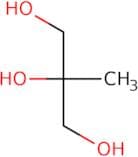
CAS 25245-58-3
:2-methylpropane-1,2,3-triol
Description:
2-Methylpropane-1,2,3-triol, commonly known as trimethylolpropane, is a triol, meaning it contains three hydroxyl (-OH) functional groups. This organic compound is characterized by its viscous, colorless liquid form and is soluble in water due to the presence of multiple hydroxyl groups, which enhance its hydrophilicity. It has a relatively high boiling point compared to simpler alcohols, reflecting its larger molecular structure and the ability to form hydrogen bonds. Trimethylolpropane is primarily used in the production of polyurethanes, alkyd resins, and as a plasticizer in various applications. Its chemical stability and low volatility make it suitable for use in coatings and adhesives. Additionally, it is non-toxic and biodegradable, which contributes to its appeal in environmentally friendly formulations. The compound's structure allows for versatility in chemical reactions, making it a valuable intermediate in organic synthesis. Overall, 2-methylpropane-1,2,3-triol is an important compound in industrial chemistry with a range of applications due to its unique properties.
Formula:C4H10O3
InChI:InChI=1/C4H10O3/c1-4(7,2-5)3-6/h5-7H,2-3H2,1H3
SMILES:CC(CO)(CO)O
Sort by
Purity (%)
0
100
|
0
|
50
|
90
|
95
|
100
Found 2 products.
2-Methyl-1,2,3-propanetriol
CAS:2-Methyl-1,2,3-propanetriol is a monomer that is used in the production of polymers. It has been shown to be an efficient cross-linking agent for metal surfaces and is used as a polymerization catalyst. 2-Methyl-1,2,3-propanetriol also plays a role in the synthesis of amino acids by acting as a substrate for kinesin and aliphatic hydrocarbon. It can be used as a feedstock for producing plastics with deionized water or aromatic hydrocarbons such as phenol. This chemical has been shown to be pluripotent in mammalian cells and can act as a cationic surfactant.
Formula:C4H10O3Purity:Min. 95 Area-%Color and Shape:Clear LiquidMolecular weight:106.12 g/mol