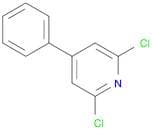
CAS 25297-51-2
:2,6-dichloro-4-phenylpyridine
Description:
2,6-Dichloro-4-phenylpyridine is an organic compound characterized by its pyridine ring substituted with two chlorine atoms at the 2 and 6 positions and a phenyl group at the 4 position. This compound typically appears as a solid or crystalline substance and is known for its potential applications in pharmaceuticals and agrochemicals. It exhibits properties such as moderate solubility in organic solvents and limited solubility in water, which is common for halogenated pyridine derivatives. The presence of chlorine atoms contributes to its reactivity, making it a useful intermediate in various chemical syntheses. Additionally, the phenyl group enhances its aromatic character, potentially influencing its biological activity. Safety data indicates that, like many chlorinated compounds, it should be handled with care due to potential toxicity and environmental concerns. Overall, 2,6-dichloro-4-phenylpyridine is a compound of interest in both synthetic chemistry and material science, warranting further investigation into its properties and applications.
Formula:C11H7Cl2N
InChI:InChI=1/C11H7Cl2N/c12-10-6-9(7-11(13)14-10)8-4-2-1-3-5-8/h1-7H
SMILES:c1ccc(cc1)c1cc(Cl)nc(c1)Cl
Synonyms:- 2,6-Dichloro-4-phenyl-pyridine
- Pyridine, 2,6-Dichloro-4-Phenyl-
Sort by
Purity (%)
0
100
|
0
|
50
|
90
|
95
|
100
Found 4 products.
2,6-Dichloro-4-phenyl-pyridine
CAS:Formula:C11H7Cl2NPurity:98%Color and Shape:SolidMolecular weight:224.08602,6-Dichloro-4-phenylpyridine
CAS:2,6-Dichloro-4-phenylpyridinePurity:95%Color and Shape:SolidMolecular weight:224.09g/mol2,6-Dichloro-4-phenylpyridine
CAS:Formula:C11H7Cl2NPurity:98%Color and Shape:SolidMolecular weight:224.082,6-Dichloro-4-phenylpyridine
CAS:2,6-Dichloro-4-phenylpyridine is a chemosensor that can be used to detect the presence of aromatic compounds. It has a modular structure consisting of an emission domain and a substrate binding domain. The fluorophore is reversibly bound to the substrate binding domain, which means that it can be detached from the substrate when the desired molecule is detected. This sensor has been shown to have high selectivity for aromatic molecules in both water and organic solvents. 2,6-Dichloro-4-phenylpyridine has also been studied structurally and found to react with a number of other chemical entities such as thiocyanate ion, nitrobenzene, and nitrophenol.
Formula:C11H7Cl2NPurity:Min. 95%Molecular weight:224.09 g/mol