


CAS 25316-40-9
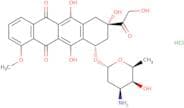
:Doxorubicin hydrochloride
Description:
Doxorubicin hydrochloride is an anthracycline antibiotic commonly used in cancer chemotherapy. It is characterized by its bright red color and is known for its potent antitumor activity. The compound works by intercalating DNA, thereby inhibiting the synthesis of nucleic acids and disrupting the replication of cancer cells. Doxorubicin is soluble in water and exhibits a pH-dependent solubility profile, which is important for its formulation and administration. Its mechanism of action also involves the generation of free radicals, contributing to its cytotoxic effects. However, the use of doxorubicin is associated with several side effects, including cardiotoxicity, which limits its cumulative dose. It is typically administered intravenously and is often used in combination with other chemotherapeutic agents to enhance efficacy against various malignancies, including breast cancer, leukemia, and lymphomas. Due to its significant therapeutic benefits and potential risks, careful monitoring and management are essential during treatment.
Formula:C27H29NO11·ClH
InChI:InChI=1S/C27H29NO11.ClH/c1-10-22(31)13(28)6-17(38-10)39-15-8-27(36,16(30)9-29)7-12-19(15)26(35)21-20(24(12)33)23(32)11-4-3-5-14(37-2)18(11)25(21)34;/h3-5,10,13,15,17,22,29,31,33,35-36H,6-9,28H2,1-2H3;1H/t10-,13-,15-,17-,22+,27-;/m0./s1
InChI key:InChIKey=MWWSFMDVAYGXBV-RUELKSSGSA-N
SMILES:OC=1C2=C([C@@H](O[C@H]3C[C@H](N)[C@H](O)[C@H](C)O3)C[C@@](C(CO)=O)(O)C2)C(O)=C4C1C(=O)C=5C(C4=O)=C(OC)C=CC5.Cl
Synonyms:- (1S,3S)-3,5,12-trihydroxy-3-(hydroxyacetyl)-10-methoxy-6,11-dioxo-1,2,3,4,6,11-hexahydrotetracen-1-yl 3-amino-2,3,6-trideoxy-alpha-L-lyxo-hexopyranoside hydrochloride (1:1)
- (1S,3S)-3,5,12-trihydroxy-3-(hydroxyacetyl)-10-methoxy-6,11-dioxo-1,2,3,4,6,11-hexahydrotetracen-1-yl 3-amino-2,3,6-trideoxyhexopyranoside hydrochloride (1:1)
- (8S-Cis)-10-((3-Amino-2,3,6-Trideoxy-Alpha-L-Lyxo-Hexopyranosyl)Oxy)-7,8,9,10-Tetrahydro-6,8,11-Trihydroxy-8-(Hydroxyacetyl)-1-Methoxynaphthacene-5,12-Dione Hydrochloride
- (8S-cis)-10-[(3-Amino-2,3,6-tridesoxy-α-L-lyxo-hexopyranosyl)oxy]-7,8,9,10-tetrahydro-6,8,11-trihydroxy-8-(hydroxyacetyl)-1-methoxynaphthacen-5,12-dionhydrochlorid
- (8S-cis)-10-[(3-amino-2,3,6-trideoxy-α-L-lyxo-hexopyranosyl)oxy]-7,8,9,10-tetrahydro-6,8,11-trihydroxy-8-(hydroxyacetyl)-1-methoxynaphthacene-5,12-dione hydrochloride
- (8S-cis)-10-[(3-amino-2,3,6-tridesoxi-α-L-lyxo-hexopiranosil)oxi]-7,8,9,10-tetrahidro-6,8,11-trihidroxi-8-(hidroxiacetil)-1-metoxinaftaceno-5,12-diona, clorhidrato
- (8S-cis)-10-[(3-amino-2,3,6-tridesoxy-α-L-lyxo-hexopyrannosyl)oxy]-7,8,9,10-tetrahydro-6,8,11-trihydroxy-8-(hydroxyacetyl)-1-methoxynaphtacene-5,12-dione, chlorhydrate
- 5,12-Naphthacenedione, 10-[(3-amino-2,3,6-trideoxy-α-<span class="text-smallcaps">L</span>-lyxo-hexopyranosyl)oxy]-7,8,9,10-tetrahydro-6,8,11-trihydroxy-8-(2-hydroxyacetyl)-1-methoxy-, hydrochloride (1:1), (8S,10S)-
- 5,12-Naphthacenedione, 10-[(3-amino-2,3,6-trideoxy-α-<span class="text-smallcaps">L</span>-lyxo-hexopyranosyl)oxy]-7,8,9,10-tetrahydro-6,8,11-trihydroxy-8-(hydroxyacetyl)-1-methoxy-, hydrochloride, (8S,10S)-
- 5,12-Naphthacenedione, 10-[(3-amino-2,3,6-trideoxy-α-<span class="text-smallcaps">L</span>-lyxo-hexopyranosyl)oxy]-7,8,9,10-tetrahydro-6,8,11-trihydroxy-8-(hydroxyacetyl)-1-methoxy-, hydrochloride, (8S-cis)-
- 5,12-Naphthacenedione, 10-[(3-amino-2,3,6-trideoxy-α-L-lyxo-hexopyranosyl)oxy]-7,8,9,10-tetrahydro-6,8,11-trihydroxy-8-(2-hydroxyacetyl)-1-methoxy-, hydrochloride (1:1), (8S,10S)-
- 5,12-Naphthacenedione, 10-[(3-amino-2,3,6-trideoxy-α-L-lyxo-hexopyranosyl)oxy]-7,8,9,10-tetrahydro-6,8,11-trihydroxy-8-(hydroxyacetyl)-1-methoxy-, hydrochloride, (8S,10S)-
- 5,12-Naphthacenedione, 10-[(3-amino-2,3,6-trideoxy-α-L-lyxo-hexopyranosyl)oxy]-7,8,9,10-tetrahydro-6,8,11-trihydroxy-8-(hydroxyacetyl)-1-methoxy-, hydrochloride, (8S-cis)-
- ADM hydrochloride
- ADR
- Adriablastina CS
- Adriacin
- Adriamycin
- Adriamycin, hydrochloride
- Adriblastin
- Adriblastina
- Adriblastina RD
- Adrosal
- Ameisu hydrochloride
- Caelyx pegylated liposomal
- DOX HCl
- Doxolipad
- Doxorubicin, HCl
- Doxorubicin-LANS
- Doxorubicin-TEVA
- Doxourbicin HCl
- Fi 106
- Fi 6804
- Hydroxydaunorubicin hydrochloride
- Lipo-Dox
- Lipodox
- Myocet liposomal
- See more synonyms
Sort by
Purity (%)
0
100
|
0
|
50
|
90
|
95
|
100
Doxorubicin hydrochloride
CAS:Doxorubicin is a cytotoxic drug that belongs to the class of anthracyclines. It is used as an anticancer agent and in the treatment of various types of cancer. Doxorubicin has been shown to inhibit glucose uptake by cells, which may be due to its ability to form disulfide bonds with proteins. Doxorubicin also binds to iron-sulfur clusters, causing cell lysis, which may lead to tumor necrosis. In vitro assays have shown that doxorubicin inhibits drug transporter function, leading to reduced cellular uptake of drugs.Formula:C27H29NO11•HClPurity:Min. 95%Molecular weight:579.98 g/molDoxorubicin hydrochloride
CAS:Formula:C27H30ClNO11Purity:95.0%Color and Shape:Solid, Crystalline Powder or Granules or PowderMolecular weight:579.98Doxorubicin hydrochloride, 10 mg/ml aqueous solution
CAS:Doxorubicin hydrochloride, 10 mg/ml aqueous solution, is a chemotherapeutic agent, which is an anthracycline antibiotic derived from the bacterium *Streptomyces peucetius var. caesius*. Its mode of action involves the intercalation into DNA, disrupting the replication and transcription processes crucial for cancer cell proliferation. Additionally, it generates free radicals that cause further damage to cellular structures and inhibit topoisomerase II, thereby preventing the unwinding of DNA necessary for replication.Formula:C27H29NO11•HClPurity:Min. 95%Color and Shape:PowderMolecular weight:579.98 g/molDoxorubicin hydrochloride (Standard)
CAS:Doxorubicin hydrochloride (Standard) is a reference standard for research and analysis in studies involving Doxorubicin hydrochloride. Doxorubicin hydrochloride is an anthracycline antibiotic with cytotoxic and antitumor activity. It is an effective inhibitor of human DNA topoisomerase I and II, with IC50 values of 0.8 μM and 2.67 μM, respectively. In addition to inhibiting DNA topoisomerases, it can reduce the phosphorylation of AMPK and its downstream target, acetyl-CoA carboxylase. Doxorubicin hydrochloride also induces apoptosis and autophagy. In animal studies, it is commonly used to induce models of acute renal failure, chronic kidney injury, and heart failure.Formula:C27H29NO11·HClMolecular weight:579.99Des-[(4-Amino-2,3,6-trideoxy-hexapyranosyl)oxy)-1-methyl] 2-Carboxylate Doxorubicin
CAS:Controlled ProductFormula:C20H12O7Color and Shape:NeatMolecular weight:364.305




![Des-[(4-Amino-2,3,6-trideoxy-hexapyranosyl)oxy)-1-methyl] 2-Carboxylate Doxorubicin](/_next/image/?url=https%3A%2Fstatic.cymitquimica.com%2Fproducts%2FTR%2Fthumb%2FD558001.jpg&w=3840&q=75)


