CAS 25363-69-3
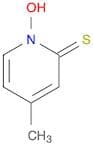
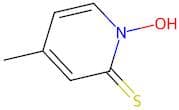
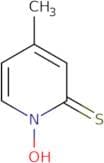
:1-Hydroxy-4-methyl-2(1H)-pyridinethione
Description:
1-Hydroxy-4-methyl-2(1H)-pyridinethione, with the CAS number 25363-69-3, is a chemical compound that belongs to the class of pyridine derivatives. It features a pyridine ring substituted with a hydroxyl group and a thione functional group, which contributes to its unique chemical properties. This compound is characterized by its potential as a chelating agent, capable of forming complexes with metal ions, which can be useful in various applications, including analytical chemistry and biochemistry. The presence of the hydroxyl group enhances its solubility in polar solvents, while the thione group can participate in various chemical reactions, such as nucleophilic attacks. Additionally, 1-Hydroxy-4-methyl-2(1H)-pyridinethione may exhibit biological activity, making it of interest in pharmaceutical research. Its stability, reactivity, and interaction with other substances can vary based on environmental conditions such as pH and temperature, which are important considerations in its practical applications.
Formula:C6H7NOS
InChI:InChI=1S/C6H7NOS/c1-5-2-3-7(8)6(9)4-5/h2-4,8H,1H3
InChI key:InChIKey=RCWJCTXRXJZSQK-UHFFFAOYSA-N
SMILES:S=C1N(O)C=CC(C)=C1
Synonyms:- 1-Hydroxy-4-methyl-2(1H)-pyridinethione
- 2(1H)-Pyridinethione, 1-hydroxy-4-methyl-
- 1-Hydroxy-4-methyl-2-pyridinethione
- 1-Hydroxy-4-methyl-1,2-dihydropyridine-2-thione
Sort by
Purity (%)
0
100
|
0
|
50
|
90
|
95
|
100
Found 4 products.
1-Hydroxy-4-methyl-1,2-dihydropyridine-2-thione
CAS:Formula:C6H7NOSPurity:95%Color and Shape:SolidMolecular weight:141.19091-Hydroxy-4-methyl-1,2-dihydropyridine-2-thione
CAS:1-Hydroxy-4-methyl-1,2-dihydropyridine-2-thionePurity:95%Molecular weight:141.19g/mol1-Hydroxy-4-methyl-1,2-dihydropyridine-2-thione
CAS:1-Hydroxy-4-methyl-1,2-dihydropyridine-2-thione is an insoluble compound that is soluble in acidic solutions. It is a white powder that can be found as sodium salts or ethylene acetyl derivatives. The yield of this compound ranges from 0.5 to 1.5%. The product has been shown to be an antibacterial agent and can also be used as a marker for the identification of bacterial colonies. This product reacts with metal ions such as copper and zinc to form coordination complexes. Thiourea is the ligand in these complexes, which are then susceptible to nucleophilic attack by strong bases such as NaOH or KOH.Formula:C6H7NOSPurity:Min. 95%Molecular weight:141.19 g/mol