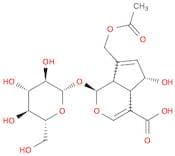
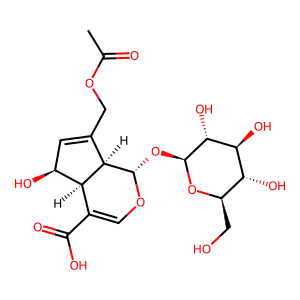
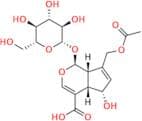
CAS 25368-11-0
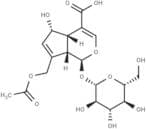
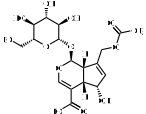
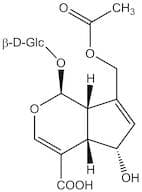
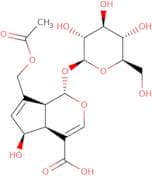
:Asperulosidic acid
Description:
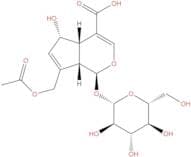
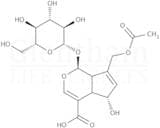
Asperulosidic acid is a naturally occurring iridoid glycoside, primarily found in various plant species, particularly in the Rubiaceae family. It is characterized by its complex molecular structure, which includes a sugar moiety attached to an iridoid core. This compound is known for its potential pharmacological properties, including anti-inflammatory, antioxidant, and antimicrobial activities. Asperulosidic acid is often studied for its role in traditional medicine and its potential therapeutic applications. It is typically soluble in polar solvents, which facilitates its extraction from plant materials. The compound's stability and reactivity can be influenced by environmental factors such as pH and temperature. Additionally, its presence in herbal formulations highlights its significance in phytochemistry and natural product research. Overall, Asperulosidic acid represents an interesting subject of study due to its bioactive properties and potential health benefits.
Formula:C18H24O12
InChI:InChI=1S/C18H24O12/c1-6(20)27-4-7-2-9(21)12-8(16(25)26)5-28-17(11(7)12)30-18-15(24)14(23)13(22)10(3-19)29-18/h2,5,9-15,17-19,21-24H,3-4H2,1H3,(H,25,26)/t9-,10+,11+,12-,13+,14-,15+,17-,18-/m0/s1
InChI key:InChIKey=DGDWCRWJRNMRKX-DILZHRMZSA-N
SMILES:O([C@H]1[C@]2([C@@](C(C(O)=O)=CO1)([C@@H](O)C=C2COC(C)=O)[H])[H])[C@@H]3O[C@H](CO)[C@@H](O)[C@H](O)[C@H]3O
Synonyms:- Cyclopenta[c]pyran-4-carboxylic acid, 1α-(β-D-glucopyranosyloxy)-1,4aα,5,7aα-tetrahydro-5β-hydroxy-7-(hydroxymethyl)-, 7-acetate
- (1S,4aS,5S,7aS)-7-[(Acetyloxy)methyl]-1-(β-D-glucopyranosyloxy)-1,4a,5,7a-tetrahydro-5-hydroxycyclopenta[c]pyran-4-carboxylic acid
- Cyclopenta[c]pyran-4-carboxylic acid, 7-[(acetyloxy)methyl]-1-(β-D-glucopyranosyloxy)-1,4a,5,7a-tetrahydro-5-hydroxy-, (1S,4aS,5S,7aS)-
- Asperulosidic acid
- Cyclopenta[c]pyran-4-carboxylic acid, 7-[(acetyloxy)methyl]-1-(β-D-glucopyranosyloxy)-1,4a,5,7a-tetrahydro-5-hydroxy-, [1S-(1α,4aα,5β,7aα)]-
Sort by
Purity (%)
0
100
|
0
|
50
|
90
|
95
|
100
Found 9 products.
Asperulosidic acid
CAS:Asperulosidic acid has been recently used in chinese medicine as a useful drug against some tumors. It has anticlastogenic activity, since the anticlastogenic irridoids have an alpha-unsaturated carbonyl group, this structure is considered to play an important role in the anticlastogenicity. Asperulosidic acid can inhibit the seed germination and growth of seedlings of large crabgrass. Asperulosidic acid, and 6-O-(beta-D-glucopyranosyl)-1-O-octanoyl-beta-D-glucopyranose are effective in suppressing 12-O-tedtradecanoylphorbol-13-acetate (TPA)- or epidermal growth factor (EGF)-induced cell transformation and associated AP-1 activity.Formula:C18H24O12Purity:95%~99%Color and Shape:PowderMolecular weight:432.378Asperulosidic acid
CAS:Formula:C18H24O12Purity:≥ 98.0%Color and Shape:White to off-white solidMolecular weight:432.38Asperulosidic acid
CAS:Asperulosidic acid (ASPA) has anti-tumor, anti-oxidant, and anti-inflammatory activities. ASPA is related to the inhibition of inflammatory cytokines.Formula:C18H24O12Purity:99.47%Color and Shape:SolidMolecular weight:432.38Ref: TM-TN1410
1mg120.00€2mg170.00€5mg260.00€1mL*10mM (DMSO)286.00€10mg432.00€25mg708.00€50mg964.00€100mg1,288.00€Asperulosidic acid
CAS:Natural glycosideFormula:C18H24O12Purity:≥ 90.0 % (HPLC)Color and Shape:PowderMolecular weight:432.38Asperulosidic acid
CAS:Asperulosidic acid is a glycoside derivative that belongs to the natural compounds. It has been shown to be an enzyme inducer in bacteria, yeast and plants. Asperulosidic acid can be found in the leaves of asperula odorata, a plant commonly known as sweet woodruff. It is also found in fructus asperuli, which is made from the fruit of asperula odorata. Asperulosidic acid has been shown to increase the activity of enzymes such as β-glucuronidase and esterase in bacteria, which may have an effect on their metabolism. This compound also increases the activity of proteases and other enzymes in plants and yeast. The matrix effect can be used to determine the concentration of this compound by measuring its effects on enzyme activity. Matrix effects can be measured using a plate test or by plasma mass spectrometry. Asperulosidic acid has been shown to have growthFormula:C18H24O12Purity:Min. 95%Color and Shape:SolidMolecular weight:432.38 g/mol