CAS 256228-64-5
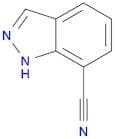
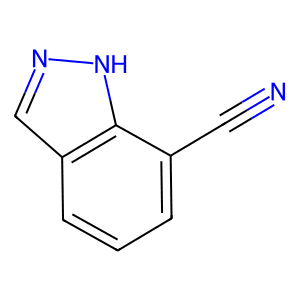
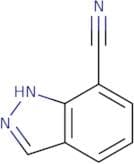
:1H-Indazole-7-carbonitrile
Description:
1H-Indazole-7-carbonitrile is a heterocyclic organic compound characterized by its indazole core, which consists of a five-membered ring containing two nitrogen atoms. The presence of a cyano group (-C≡N) at the 7-position of the indazole structure contributes to its chemical reactivity and potential applications in various fields, including medicinal chemistry and material science. This compound typically exhibits properties such as moderate solubility in organic solvents and stability under standard laboratory conditions. Its molecular structure allows for potential interactions with biological targets, making it of interest in drug discovery. Additionally, 1H-Indazole-7-carbonitrile may participate in various chemical reactions, including nucleophilic substitutions and cycloadditions, due to the electron-withdrawing nature of the cyano group. Overall, this compound represents a valuable scaffold for the development of new pharmaceuticals and agrochemicals, with ongoing research exploring its biological activities and synthetic methodologies.
Formula:C8H5N3
InChI:InChI=1/C8H5N3/c9-4-6-2-1-3-7-5-10-11-8(6)7/h1-3,5H,(H,10,11)
SMILES:c1cc(C#N)c2c(c1)cn[nH]2
Sort by
Purity (%)
0
100
|
0
|
50
|
90
|
95
|
100
Found 5 products.
1H-Indazole-7-carbonitrile
CAS:Formula:C8H5N3Purity:98%Color and Shape:SolidMolecular weight:143.14541H-Indazole-7-carbonitrile
CAS:1H-Indazole-7-carbonitrileFormula:C8H5N3Purity:≥95%Color and Shape: white to off-white solidMolecular weight:143.15g/mol1H-Indazole-7-carbonitrile
CAS:The indazoles are a group of heterocyclic compounds containing an indazole nucleus. The indazoles can be synthesized by the cycloaromatization of benzene derivatives, such as 1H-indazole-7-carbonitrile. This reaction is mediated by a variety of catalysts. It has been shown that the catalytic activity of these catalysts is due to the interaction between the substrate and the catalyst's active site. The first x-ray structure of an indazole synthase from Pseudomonas fluorescens was reported in 2009, and it was found that this enzyme has two different active sites: one for cycloaromatization reactions, which produces indazoles, and another for elimination reactions, which produce oxindoles.
Formula:C8H5N3Purity:Min. 95%Molecular weight:143.15 g/molRef: 3D-GKA22864
Discontinued product