CAS 25679-24-7
:cholecystokinin fragment 26-33 amide*non-sulfated
Description:
Cholecystokinin fragment 26-33 amide, non-sulfated, is a peptide derived from the larger cholecystokinin (CCK) molecule, which plays a crucial role in digestion and appetite regulation. This specific fragment consists of a sequence of amino acids that are involved in stimulating gallbladder contraction and promoting the release of digestive enzymes from the pancreas. The non-sulfated form indicates that it lacks sulfate modifications, which can influence its biological activity and receptor interactions. The CAS number 25679-24-7 uniquely identifies this compound in chemical databases, facilitating its study and application in research. Characteristically, this peptide is soluble in water and exhibits biological activity at nanomolar concentrations, making it significant in physiological processes. Its role in the gastrointestinal system and potential implications in appetite regulation and satiety make it a subject of interest in both pharmacological and nutritional research. Understanding its structure and function can provide insights into therapeutic approaches for digestive disorders and obesity management.
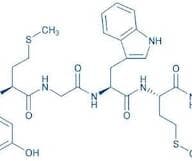
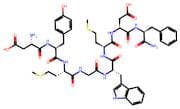
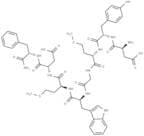
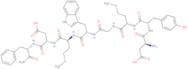
Formula:C49H62N10O13S2
InChI:InChI=1/C49H62N10O13S2/c1-73-18-16-34(55-47(70)37(21-28-12-14-30(60)15-13-28)58-44(67)32(50)23-41(62)63)45(68)53-26-40(61)54-38(22-29-25-52-33-11-7-6-10-31(29)33)48(71)56-35(17-19-74-2)46(69)59-39(24-42(64)65)49(72)57-36(43(51)66)20-27-8-4-3-5-9-27/h3-15,25,32,34-39,52,60H,16-24,26,50H2,1-2H3,(H2,51,66)(H,53,68)(H,54,61)(H,55,70)(H,56,71)(H,57,72)(H,58,67)(H,59,69)(H,62,63)(H,64,65)
SMILES:CSCCC(C(=NCC(=NC(Cc1c[nH]c2ccccc12)C(=NC(CCSC)C(=NC(CC(=O)O)C(=NC(Cc1ccccc1)C(=N)O)O)O)O)O)O)N=C(C(Cc1ccc(cc1)O)N=C(C(CC(=O)O)N)O)O
Synonyms:- Cholecystokinin Octapeptide (desulfated)
- H-Asp-Tyr-Met-Gly-Trp-Met-Asp-Phe-NH2
- N-[(2S)-2-hydrazino-3-phenylpropanoyl]-L-alpha-aspartyl-L-methionyl-L-tryptophylglycyl-N-[(1S,4S)-4-amino-5-carboxy-1-(4-hydroxybenzyl)-2,3-dioxopentyl]-L-methioninamide
- Alpha-Aspartyltyrosylmethionylglycyltryptophylmethionyl-Alpha-Aspartylphenylalaninamide
Sort by
Purity (%)
0
100
|
0
|
50
|
90
|
95
|
100
Found 6 products.
Cholecystokinin Octapeptide (desulfated)
CAS:Sincalide (desulfated)Formula:C49H62N10O13S2Purity:98.1%Color and Shape:White LyophilisateMolecular weight:1063.22Cholecystokinin Octapeptide, desulfated
CAS:Cholecystokinin Octapeptide, desulfatedPurity:≥95%Molecular weight:1063.21g/molCholecystokinin Octapeptide, desulfated
CAS:Cholecystokinin Octapeptide, desulfated (CCK Octapeptide, non-sulfated) is an octapeptide composed of 8 amino acids from cholecystokinin-8.Formula:C49H62N10O13S2Purity:97.12%Color and Shape:SolidMolecular weight:1063.21CCK octapeptide Cholecystokinin (26-33)
CAS:The octapeptide cholecystokinin (26-33), known as CCK-8, has the full biological activity of the full-length cholecystokinin (CCK). CCK acts as a hormone and neurotransmitter and is found in the GI and central nervous systems. CCK-8 is a satiety peptide that inhibits food intake.CCK-8 can also inhibit amanitin uptake into hepatocytes.Formula:C49H62N10O13S2Molecular weight:1,063.21 g/molCCK-Octapeptide (26-33) (Non-Sulfated Form)
CAS:CCK-Octapeptide (26-33) is a peptide that is a member of the cholecystokinin family of peptides. CCK-Octapeptide (26-33) is an activator of the CCK receptor and can be used for research purposes. This peptide has been shown to inhibit ion channels, which are proteins that regulate the flow of ions across cell membranes, and may be used as a pharmacological tool or research tool.
Formula:C49H62N10O13S2Purity:Min. 95%Molecular weight:1,063.2 g/molCholecystokinin Octapeptide (desulfated)
CAS:Cholecystokinin octapeptide (CCK-8) is a peptide hormone that is secreted from the pancreas. It is a conjugate of CCK and desulfated cholinesterase, which has been shown to have surfactant properties. The concentration-response curves for CCK-8 are biphasic, with an initial increase in contractility followed by a decrease. This response is caused by activation of both the B2 and B1 receptors in the paraventricular nucleus of the hypothalamus and subsequently release of pancreatic enzymes into the bloodstream. CCK-8 has also been shown to stimulate protein synthesis in gland cells such as those found in the pancreas.Formula:C49H62N10O13S2Purity:Min. 95%Molecular weight:1,063.21 g/mol