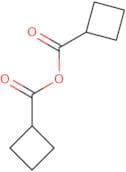
CAS 25774-35-0
:cyclobutanecarboxylic anhydride
Description:
Cyclobutanecarboxylic anhydride is a cyclic anhydride derived from cyclobutanecarboxylic acid. It features a four-membered ring structure, which contributes to its unique chemical properties. This compound is characterized by its relatively high reactivity due to the strained ring system, making it a useful intermediate in organic synthesis. Cyclobutanecarboxylic anhydride can participate in various chemical reactions, including nucleophilic acyl substitution and ring-opening reactions, which are valuable in the synthesis of larger molecules. It is typically a colorless to pale yellow liquid at room temperature and has a distinctive odor. The compound is soluble in organic solvents, but its solubility in water is limited. Safety precautions should be taken when handling this substance, as it can be irritant to the skin and eyes, and proper ventilation is recommended due to potential inhalation hazards. Overall, cyclobutanecarboxylic anhydride serves as an important building block in the development of pharmaceuticals, agrochemicals, and other organic compounds.
Formula:C10H14O3
InChI:InChI=1/C10H14O3/c11-9(7-3-1-4-7)13-10(12)8-5-2-6-8/h7-8H,1-6H2
SMILES:C1CC(C1)C(=O)OC(=O)C1CCC1
Synonyms:- Cyclobutanecarboxylic anhydride
Sort by
Purity (%)
0
100
|
0
|
50
|
90
|
95
|
100
Found 2 products.
Cyclobutanecarboxlic acid anhydride
CAS:Formula:C10H14O3Purity:90.0%Color and Shape:Liquid, ClearMolecular weight:182.219Cyclobutanecarboxylic acid anhydride
CAS:Cyclobutanecarboxylic acid anhydride is a synthetic primary amino acid. It is used as an antibacterial agent in medicines and has been shown to be a beta-lactamase inhibitor. Cyclobutanecarboxylic acid anhydride has also been shown to inhibit the synthesis of prostaglandins such as PGE2, which may account for its immunosuppressive properties. This molecule is a component of the structural formula for many drugs, including ampicillin and cefotaxime. Cyclobutanecarboxylic acid anhydride can be found in both enantiomers (D- and L-) and diastereomers (meso-, D-, L-, DL-, meso-D-, meso-L-, meso-DL-) with different physiological activities. The D-enantiomer has been found to have a greater thermal expansion coefficient than the L-enantiomer.Formula:C10H14O3Purity:Min. 95%Molecular weight:182.22 g/mol