CAS 25775-03-5
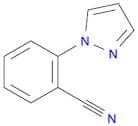
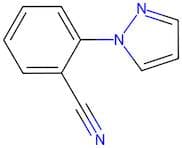
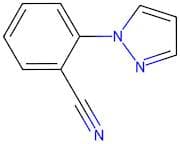
:2-(1H-pyrazol-1-yl)benzonitrile
Description:
2-(1H-pyrazol-1-yl)benzonitrile, with the CAS number 25775-03-5, is an organic compound characterized by the presence of a pyrazole ring and a benzonitrile moiety. This compound features a pyrazole group, which is a five-membered ring containing two nitrogen atoms, directly attached to a benzene ring that is further substituted with a nitrile group (-C≡N). The presence of the nitrile group contributes to its polarity and potential reactivity, making it useful in various chemical applications. The compound is typically a solid at room temperature and may exhibit moderate solubility in organic solvents. Its structure allows for potential interactions in biological systems, making it of interest in medicinal chemistry and drug design. Additionally, the compound may exhibit specific spectral characteristics in techniques such as NMR and IR spectroscopy, which can be utilized for its identification and characterization in laboratory settings. Overall, 2-(1H-pyrazol-1-yl)benzonitrile is a versatile compound with applications in research and development.
Formula:C10H7N3
InChI:InChI=1/C10H7N3/c11-8-9-4-1-2-5-10(9)13-7-3-6-12-13/h1-7H
SMILES:c1ccc(c(c1)C#N)n1cccn1
Sort by
Purity (%)
0
100
|
0
|
50
|
90
|
95
|
100
Found 5 products.
2-(1H-Pyrazol-1-yl)benzonitrile
CAS:Formula:C10H7N3Purity:98%Color and Shape:SolidMolecular weight:169.18272-(1H-Pyrazol-1-yl)benzonitrile
CAS:2-(1H-Pyrazol-1-yl)benzonitrilePurity:98%Molecular weight:169.18g/mol2-(1H-Pyrazol-1-yl)benzonitrile
CAS:2-(1H-Pyrazol-1-yl)benzonitrile is used as a catalyst for the synthesis of pharmaceuticals. It can be prepared by reacting pyrrolidine with aniline in chloroform. Pyrrolidine is then reacted with 2-chlorobenzonitrile and the resulting product, 2-(1H-pyrazol-1-yl)benzonitrile, is isolated from the reaction mixture by extraction with diethyl ether. The compound has a ligand that binds to metal ions and is also used as a chelating agent. This property allows it to catalyse reactions involving nucleophiles and halides. It can also be used in amino acid coupling reactions, yielding amides or imines, respectively.
Formula:C10H7N3Purity:Min. 95%Molecular weight:169.18 g/mol