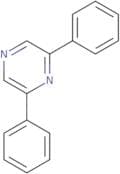
CAS 25827-94-5
:2,6-diphenylpyrazine
Description:
2,6-Diphenylpyrazine is an organic compound characterized by its pyrazine ring, which is a six-membered aromatic heterocycle containing two nitrogen atoms at the 1 and 4 positions. This compound features two phenyl groups attached to the 2 and 6 positions of the pyrazine ring, contributing to its aromatic nature and enhancing its stability. It is typically a solid at room temperature and exhibits a relatively high melting point. 2,6-Diphenylpyrazine is known for its potential applications in various fields, including organic synthesis and as a building block in the development of pharmaceuticals and agrochemicals. Its structure allows for interesting electronic properties and reactivity, making it a subject of study in materials science and medicinal chemistry. Additionally, it may exhibit fluorescence, which can be useful in certain analytical applications. As with many organic compounds, handling should be done with care, considering safety data and potential hazards associated with its use.
Formula:C16H12N2
InChI:InChI=1/C16H12N2/c1-3-7-13(8-4-1)15-11-17-12-16(18-15)14-9-5-2-6-10-14/h1-12H
SMILES:c1ccc(cc1)c1cncc(c2ccccc2)n1
Sort by
Purity (%)
0
100
|
0
|
50
|
90
|
95
|
100
Found 1 products.
2,6-Diphenylpyrazine
CAS:2,6-Diphenylpyrazine (2,6-DPP) is a cross-linked complex that contains 4-methoxyphenylboronic acid. It has been shown to react with anions and form coordination complexes with imidazoline ligands. The coordination chemistry of 2,6-DPP is dependent on the structure of the anion. For example, in acetonitrile or nitrate solutions, 2,6-DPP coordinates to the negative charge through two nitrogen atoms and two carbon atoms. In aqueous solutions containing halides such as chloride or fluoride ions, 2,6-DPP coordinates through three nitrogen atoms and one carbon atom.Formula:C16H12N2Purity:Min. 95%Molecular weight:232.28 g/mol