CAS 25844-73-9
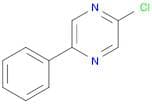
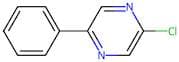
:2-chloro-5-phenylpyrazine
Description:
2-Chloro-5-phenylpyrazine is an organic compound characterized by its pyrazine ring, which is a six-membered aromatic heterocycle containing two nitrogen atoms. The presence of a chlorine atom at the second position and a phenyl group at the fifth position of the pyrazine ring contributes to its unique chemical properties. This compound typically exhibits a pale yellow to light brown appearance and is soluble in organic solvents. Its molecular structure allows for various chemical reactions, including electrophilic substitution due to the electron-withdrawing nature of the chlorine atom. 2-Chloro-5-phenylpyrazine is of interest in pharmaceutical and agrochemical research, as it may serve as a building block for the synthesis of more complex molecules. Additionally, its potential biological activity makes it a subject of investigation in medicinal chemistry. Safety data should be consulted for handling and usage, as with any chemical substance, to ensure proper precautions are taken.
Formula:C10H7ClN2
InChI:InChI=1/C10H7ClN2/c11-10-7-12-9(6-13-10)8-4-2-1-3-5-8/h1-7H
SMILES:c1ccc(cc1)c1cnc(cn1)Cl
Synonyms:- 2-Chlor-5-phenylpyrazin
- Pyrazine, 2-Chloro-5-Phenyl-
- 2-Chloro-5-phenylpyrazine
Sort by
Purity (%)
0
100
|
0
|
50
|
90
|
95
|
100
Found 4 products.
2-Chloro-5-phenylpyrazine
CAS:2-Chloro-5-phenylpyrazinePurity:95%Color and Shape:SolidMolecular weight:190.63g/mol2-Chloro-5-phenylpyrazine
CAS:2-Chloro-5-phenylpyrazine (2CPP) is an amide nucleophile that reacts with diphenyl to form the corresponding diphenyl amide. 2CPP is a nucleophilic compound that yields the product in high yields. The attack of the nucleophile on the electrophilic carbon atom generates a new carbon-nucleus bond, and another molecule of 2CPP or other nucleophile can attack the same carbon atom to produce a second product. 2CPP reacts with potassium to form a white solid, which is then heated to release hydrogen chloride gas.Formula:C10H7ClN2Purity:Min. 95%Molecular weight:190.63 g/mol