CAS 25856-01-3
:1,3-Propanedione, 1-(4-bromophenyl)-3-phenyl-
Description:
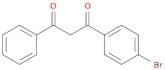
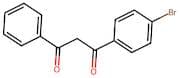
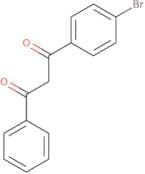
1,3-Propanedione, 1-(4-bromophenyl)-3-phenyl-, also known by its CAS number 25856-01-3, is an organic compound characterized by its diketone structure, featuring two carbonyl groups (C=O) flanked by a 4-bromophenyl group and a phenyl group. This compound typically exhibits a pale yellow to light brown appearance and is soluble in organic solvents such as ethanol and acetone, but has limited solubility in water due to its hydrophobic aromatic components. The presence of the bromine atom enhances its reactivity, making it a useful intermediate in organic synthesis, particularly in the development of pharmaceuticals and agrochemicals. Its chemical properties include the ability to undergo various reactions such as nucleophilic addition and condensation, which are common for diketones. Additionally, the compound may exhibit interesting optical properties and potential biological activity, making it a subject of interest in medicinal chemistry. Safety data should be consulted for handling, as halogenated compounds can pose health risks.
Formula:C15H11BrO2
Sort by
Purity (%)
0
100
|
0
|
50
|
90
|
95
|
100
Found 4 products.
1-(4-Bromophenyl)-3-phenylpropane-1,3-dione
CAS:Formula:C15H11BrO2Purity:95%Molecular weight:303.15061-(4-Bromophenyl)-3-phenylpropane-1,3-dione
CAS:1-(4-Bromophenyl)-3-phenylpropane-1,3-dionePurity:95%Molecular weight:303.15g/molRef: 10-F671025
50mg110.00€100mg163.00€250mg221.00€500mg329.00€1g419.00€2.5g721.00€5g1,142.00€10g2,101.00€1-(4-Bromophenyl)-3-phenylpropane-1,3-dione
CAS:1-(4-Bromophenyl)-3-phenylpropane-1,3-dione is a ternary molecule that contains one electron in its ground state. It has a monochromatic emission spectrum with peaks at 468 nm and 544 nm. The fluorescence emission spectrum peaks at 488 nm and 527 nm. 1-(4-Bromophenyl)-3-phenylpropane-1,3-dione absorbs light in the visible range of the electromagnetic spectrum and emits light in the near infrared range of the electromagnetic spectrum. The ligand is connected to nitrogen atoms on one side of the molecule, while oxygen atoms are on the other side of the molecule. Luminescence occurs when electrons are transferred from an excited state to a lower energy state. The ternary complex is made up of three different parts: an organic compound, an inorganic compound and an electron donor or acceptor. This molecule's electron donor is carbon monoxideFormula:C15H11BrO2Purity:Min. 95%Molecular weight:303.15 g/mol