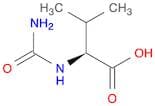
CAS 26081-02-7
:N-(Aminocarbonyl)-L-valine
Description:
N-(Aminocarbonyl)-L-valine, also known by its CAS number 26081-02-7, is an amino acid derivative that features a carbonyl group attached to the amino group of L-valine. This compound is characterized by its structural components, which include an amino group (-NH2), a carboxyl group (-COOH), and a side chain characteristic of valine, which is an isopropyl group. The presence of the carbonyl group enhances its reactivity and potential applications in biochemical processes. N-(Aminocarbonyl)-L-valine is typically soluble in water due to its polar functional groups, making it suitable for various biological and chemical applications. It may play a role in peptide synthesis and can be utilized in research related to protein structure and function. Additionally, its properties may be influenced by factors such as pH and temperature, which can affect its ionization state and solubility. Overall, this compound is of interest in both synthetic and biological chemistry contexts.
Formula:C6H12N2O3
InChI:InChI=1S/C6H12N2O3/c1-3(2)4(5(9)10)8-6(7)11/h3-4H,1-2H3,(H,9,10)(H3,7,8,11)/t4-/m0/s1
InChI key:InChIKey=JDXMIYHOSFNZKO-BYPYZUCNSA-N
SMILES:[C@H](NC(N)=O)([C@H](C)C)C(O)=O
Synonyms:- Valine, N-carbamoyl-, L-
- N-Carbamoyl-L-valine
- L-Valine, N-(aminocarbonyl)-
- N-Carbamoyl-S-valine
- N-(Aminocarbonyl)-L-valine
Sort by
Purity (%)
0
100
|
0
|
50
|
90
|
95
|
100
Found 2 products.
(2S)-2-(Carbamoylamino)-3-methylbutanoic acid
CAS:<p>(2S)-2-(Carbamoylamino)-3-methylbutanoic acid is a synthetic, racemic amino acid that has been used to study the kinetics and dynamics of protein folding. The optimum concentration of (2S)-2-(carbamoylamino) 3-methylbutanoic acid for monitoring kinetic studies is 1.0 mM in aqueous solution at pH 7.4. It can be synthesized from l-alanine using acetonitrile as the solvent and enantiomerically pure 2-chloroacetic acid as the raw material. The synthesis of (2S)-2-(carbamoylamino) 3-methylbutanoic acid is achieved through a series of steps involving chlorination, hydrolysis, and racemization using hydantoin. This compound is also characterized by its high degree of hydrophilicity, which makes it suitable for use in techniques such as liquid chromatography or gas chromatography</p>Formula:C6H12N2O3Purity:Min. 95%Molecular weight:160.17 g/mol