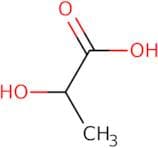
CAS 26100-51-6
:(±)-Poly(lactic acid)
Description:
(±)-Poly(lactic acid) (PLA) is a biodegradable and bioactive thermoplastic made from lactic acid monomers. It is characterized by its ability to decompose into non-toxic byproducts, making it an environmentally friendly alternative to traditional petroleum-based plastics. PLA exhibits good mechanical properties, including tensile strength and flexibility, which can vary depending on its molecular weight and the ratio of its stereoisomers (D- and L-lactic acid). It has a glass transition temperature that allows it to be processed using standard thermoplastic techniques such as injection molding and extrusion. PLA is also known for its transparency and gloss, making it suitable for various applications, including packaging, textiles, and biomedical devices. Additionally, it has a relatively low melting temperature, which can limit its use in high-temperature applications. Its biodegradability is influenced by environmental conditions, such as temperature and humidity, and it typically breaks down into lactic acid in composting environments. Overall, (±)-Poly(lactic acid) represents a significant advancement in sustainable materials science.
Formula:(C3H6O3)x
InChI:InChI=1/C3H6O3/c1-2(4)3(5)6/h2,4H,1H3,(H,5,6)
InChI key:InChIKey=JVTAAEKCZFNVCJ-UHFFFAOYSA-N
SMILES:C(C(O)=O)(C)O
Synonyms:- (.+-.)-2-Hydroxypropanoic acid homopolymer
- (.+-.)-Lactic acid homopolymer
- (.+-.)-Poly(lactic acid)
- <span class="text-smallcaps">D</smallcap><smallcap>L</span>-Lactic acid polymer
- <span class="text-smallcaps">DL</span>-Lactic acid homopolymer
- <span class="text-smallcaps">DL</span>-Polylactic acid
- Acide lactique homopolymerise
- D,L-polylactic acid
- DL-Lactic acid homopolymer
- DL-Lactic acid polymer
- DL-Polylactic acid
- Lactates, polylactates
- Lactic acid polymer
- Lactic acid, polyesters
- Lactic acid, polymers
- NeoOrtho
- New-Fill
- Poly(<span class="text-smallcaps">D</smallcap><smallcap>L</span>-lactic acid)
- Poly(DL-lactic acid)
- Poly(dl-lactate)
- Poly(lactic acid) (High M.Wt.)
- Polycondensate of lactic acid (insoluble in water, acid and alkali also containing 1% or less of component having less than 1,000 of molecular weight)
- Polylactate
- Polylactates
- Polylactic acid
- Propanoic acid, 2-hydroxy-, homopolymer
- Poly(L-lactide), acrylate terminated
- PLA
- POLYLACTIC ACID ISO 9001:2015 REACH
- polylactic acid standard 78'000
- 2-hydroxy-propanoicacihomopolymer
- China Polylactic acid PLA plastics
- 2 k PLLA-ATRP
- POLYD,L-LACTICACIDNANOPARTICLES
- PLLA acrylate
- Poly(L-lactide) average Mn 5,000, PDI <=1.2
- POLY(2-HYDROXYPROPIONIC ACID)
- polylactic acid(PLA)
- 3DXMAX(TM) CFR-PLA carbon fiber reinforced PLA 3D printing filament black, diam. 2.85 mm
- 3DXMAX(TM) CFR-PLA carbon fiber reinforced PLA 3D printing filament black, diam. 1.75 mm
- Polylactic acid Mw ~60,000
- Poly(L-lactic Acid)(Mw ~60,000)
- Poly(L-lactide) average Mn 20,000, PDI <=1.1
- Poly(L-lactide) viscosity ~2.0 dL/g, 0.1 % (w/v) in chloroforM(25 C)
- PLA_PLLA_PDLA_PLLA_PDLLA
- Poly(lactic acid) (Low M.Wt.)
- ATRP terminated PLLA
- 3DXMAX(TM) CFR-PLA carbon fiber reinforced PLA 3D printing filament
- Poly(L-lactide), propargyl terminated
- Polylactic acid Standard 225μ000
- PLLA acetylene
- 3DXMAX CFR-PLA carbon fiber reinforced PLA 3D printing filament
- POLYLACTIC ACID STANDARD 78'000 CERTIF. REF. MAT. ACC.TO BAM
- Poly(2-hydroxypropionic acid), Polylactic acid
- polylactide, polylactic acid, PLA
- ATRP Macromonomer
- Poly(L-lactide) average Mn 10,000, PDI <=1.1
- Poly(L-lactide) viscosity ~4.0 dL/g, 0.1 % (w/v) in chloroform(25 C)
- Poly(L-lactide), 2-bromoisobutyryl terminated
- Poly(L-lactide) average Mn 50,000
- propargyl PLLA
- acrylate-PLA-OH
- POLYLACTIC ACID STANDARD 225'000 CERT.
- 10 k PLLA-ATRP
- PDLA
- polylactide, polylactic acid
- See more synonyms
Sort by
Purity (%)
0
100
|
0
|
50
|
90
|
95
|
100
Found 7 products.
Propanoic acid, 2-hydroxy-, homopolymer
CAS:Formula:C3H6O3Color and Shape:SolidMolecular weight:90.0779Poly(DL-lactic acid) (Mw=ca. 100000, ester terminated)
CAS:Color and Shape:White to Light yellow powder to crystalPoly(DL-lactic acid) (Mw=ca. 300000, ester terminated)
CAS:Color and Shape:White to Light yellow powder to crystalPoly(DL-lactic acid) (Mw=ca. 200000, ester terminated)
CAS:Color and Shape:White to Almost white powder to crystalPolylactic acid - MW 40,000~80,000
CAS:Polylactic acid is a polymer that has been used as a suture and in tissue engineering. It is synthesized by the polymerization of lactic acid, which is derived from renewable resources such as cornstarch, potatoes, and sugar beets. Polylactic acid has been shown to be effective against squamous carcinoma cells and colorectal adenocarcinoma cells. The mechanism of action for polylactic acid is not fully understood but it may have an effect on mitochondrial membrane potential, blood sampling, multivariate logistic regression, antibacterial efficacy, enzyme activities and transcriptional regulation. This polymer may also inhibit the growth of bacteria through the inhibition of glycol ethers or benzalkonium chloride.Color and Shape:White Powder