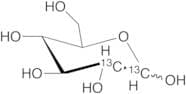
CAS 261728-61-4
:a-D-Glucopyranose-1,2-13C2 (9CI)
Description:
α-D-Glucopyranose-1,2-^13C2 (9CI) is a stable isotope-labeled form of glucose, specifically designed for use in various biochemical and metabolic studies. This compound features a six-membered pyranose ring structure, characteristic of glucose, with the incorporation of two carbon-13 (^13C) isotopes at the first and second carbon positions. The presence of these isotopes allows researchers to trace metabolic pathways and study carbohydrate metabolism with enhanced precision using techniques such as nuclear magnetic resonance (NMR) spectroscopy and mass spectrometry. As a monosaccharide, it exhibits typical properties of sugars, including solubility in water and the ability to participate in glycosidic bond formation. Its labeling with ^13C makes it particularly valuable in research fields such as biochemistry, nutrition, and pharmacology, where understanding the dynamics of glucose metabolism is crucial. The compound is typically handled under standard laboratory conditions, and its stability allows for extended use in experimental setups.
Formula:C6H12O6
Synonyms:- D-[1,2-13C2]Glucose
- D-GLUCOSE-1,2-13C2
Sort by
The purity filter is not visible because current products do not have associated purity data for filtering.
Found 2 products.
D-Glucose-1,2-13C2
CAS:<p>Applications Labelled D-Glucose is a simple sugar that is present in plants. A monosaccharide that may exist in open chain or cyclic conformation if in solution. It plays a vital role in photosynthesis and fuels the energy required for cellular respiration. D-Glucose is used in various metabolic processes including enzymic synthesis of cyclohexyl-α and β-D-glucosides. Can also be used as a diagnostic tool in detection of type 2 diabetes mellitus and potentially Huntington's disease through analysis of blood-glucose in type 1 diabetes mellitus.<br>References Wang, R., et al.: J. Mol. Catal. B. Enz., 56, 131 (2009); Springhorn, C. et al.: J. Clin. Endocrinol. Metab., 97, 4640 (2012); Hashimoto, K. et al.: J. Clin. Endocrinol. Metab., 97, 3016 (2012); Avelange, M. et al.: Plant. Phys., 94, 1157 (1990); Cramer, C. et al.: J. Chem. Soc., 115, 5745 (1993);<br></p>Formula:C2C4H12O6Color and Shape:NeatMolecular weight:182.14