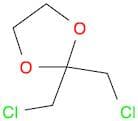
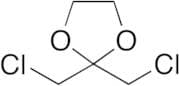
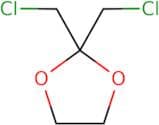
CAS 26271-50-1
:2,2-bis(chloromethyl)-1,3-dioxolane
- 1,3-Dioxolane, 2,2-Bis(Chloromethyl)-
- 2,2-Bis(chloromethyl)-1,3-dioxolane
2,2-Bis(chloromethyl)-1,3-dioxolane
CAS:Formula:C5H8Cl2O2Color and Shape:LiquidMolecular weight:171.02181,3-Dichloroacetone Ethylene Ketal
CAS:Controlled ProductApplications 1,3-Dichloroacetone Ethylene Ketal (cas# 26271-50-1) is a compound useful in organic synthesis.
Formula:C5H8Cl2O2Color and Shape:NeatMolecular weight:171.022,2-Bis(chloromethyl)-1,3-dioxolane
CAS:2,2-Bis(chloromethyl)-1,3-dioxolane is a chemical intermediate that can be used in the production of polyester resins. It is a colorless liquid with an unpleasant odor. 2,2-Bis(chloromethyl)-1,3-dioxolane reacts with ethylene and glycol to produce polyester resins. This reaction occurs at high temperatures and produces a mixture of products such as diols and triols. When heated in acidic conditions, the compound hydrolyzes to form dihydroxyacetone and p-toluenesulfonic acid. The compound is also used as an industrial solvent for acidic materials. Recrystallizing the product from ethylene glycol results in a white crystalline powder that can be used in the manufacture of other chemicals such as sulfate salts.
Formula:C5H8Cl2O2Purity:Min. 95%Molecular weight:171.02 g/mol