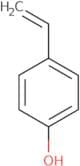
CAS 2628-17-3
:4-Vinylphenol
Description:
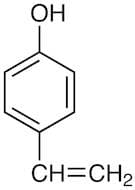
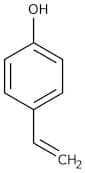
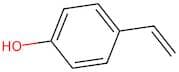
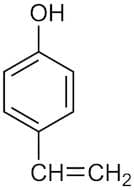
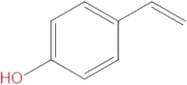
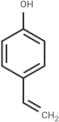
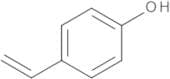
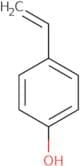
4-Vinylphenol, also known as p-vinylphenol, is an organic compound characterized by a phenolic structure with a vinyl group attached to the para position of the aromatic ring. Its molecular formula is C8H8O, and it features a hydroxyl group (-OH) that imparts typical phenolic properties, such as reactivity and the ability to form hydrogen bonds. This compound is a colorless to light yellow liquid at room temperature and has a characteristic odor. 4-Vinylphenol is soluble in organic solvents and exhibits moderate solubility in water. It is primarily used in the production of polymers and resins, particularly in the synthesis of phenolic resins and as a monomer in various copolymer applications. Additionally, it can serve as an intermediate in organic synthesis and has potential applications in the field of materials science. Due to its reactive vinyl group, 4-vinylphenol can undergo polymerization and other chemical reactions, making it a valuable compound in various industrial processes. Safety precautions should be taken when handling this substance, as it may cause irritation to the skin and eyes.
Formula:C8H8O
InChI:InChI=1S/C8H8O/c1-2-7-3-5-8(9)6-4-7/h2-6,9H,1H2
InChI key:InChIKey=FUGYGGDSWSUORM-UHFFFAOYSA-N
SMILES:C(=C)C1=CC=C(O)C=C1
Synonyms:- 4-Ethenylphenol
- 4-Hydroxystyrene
- P-Vinilfenol
- Phenol, 4-ethenyl
- Phenol, p-vinyl-
- p-Hydroxystyrene
- p-Oxystyrene
- p-Vinylphenol
Sort by
Purity (%)
0
100
|
0
|
50
|
90
|
95
|
100
Found 12 products.
4-Vinylphenol (ca. 10% in Propylene Glycol)
CAS:Formula:C8H8OColor and Shape:Light yellow to Yellow to Orange clear liquidMolecular weight:120.154-Vinylphenol, min 10% soln. in propylene glycol
CAS:4-Vinylphenol acts as a monomer and used in the preparation of poly-4-vinylphenol polymer, which is used in electronics as a dielectric layer in organic transistors in organic thin-film-transistor liquid-crystal displays (TFT LCD). It is a phenolic compound and presents in wine and beer. This ThermFormula:C8H8OColor and Shape:Liquid, Clear colorless to yellow or orangeMolecular weight:120.154-Vinylphenol
CAS:Formula:C8H8OPurity:>98.0%(GC)Color and Shape:White to Light yellow powder to crystalMolecular weight:120.154-Vinylphenol
CAS:4-Vinylphenol, a metabolite from lactic acid bacteria in wine, induces apoptosis. Found in Hedyotis diffusa Willd.Formula:C8H8OPurity:97.07%Color and Shape:SolidMolecular weight:120.154-Vinylphenol, 10 wt.% In Propylene Glycol
CAS:Applications 4-Vinylphenol, 10 wt.% In propylene glycol (cas# 2628-17-3) is a useful research chemical.
Formula:C8H8OColor and Shape:Single SolutionMolecular weight:120.144-Vinylphenol, 10 wt % in propylene glycol
CAS:4-Vinylphenol is a chemical compound that has the molecular formula CH2=CHC6H4OH. It is a hydroxyl derivative of phenol and has the chemical structure of a phenolic acid. This compound is used in the laboratory to study the effects of cationic polymerization on surface methodology and activation energies. 4-Vinylphenol inhibits Saccharomyces cerevisiae strain, which is commonly found in urine samples as well as in recombinant cells, by inhibiting cell growth and reducing ATP production. The inhibition of Saccharomyces cerevisiae strain by 4-vinylphenol can be reversed with p-hydroxybenzoic acid or cationic polymerization. The molecule also contains two nitrogen atoms that can form hydrogen bonds with other molecules, such as water molecules. It is possible that these hydrogen bonds are what allow 4-vinylphenol to inhibit Saccharomyces cerevisiae strain, although this hypothesis hasFormula:C8H8OPurity:Min. 95 Area-%Color and Shape:Colorless Clear LiquidMolecular weight:120.15 g/mol4-Vinylphenol
CAS:4-Vinylphenol is a phenolic compound that is used as an industrial chemical. It has been shown to inhibit the growth of bacteria in nonpolar solvents, including aerobacter aerogenes and Saccharomyces cerevisiae. 4-Vinylphenol inhibits bacterial growth through its ability to disrupt the hydrogen bonds between proteins and nucleic acids. This results in increased hydroxyl groups on the protein surface and cationic polymerization of the DNA gyrase enzyme, which disrupts its function. 4-Vinylphenol has also been shown to activate mouse CD-1 cells by increasing their sensitivity to chemical inhibitors, such as ethidium bromide or 2',7'-dichlorofluorescin diacetate (DCFH2DA).Formula:C8H8OPurity:Min. 95%Color and Shape:LiquidMolecular weight:120.15 g/mol4-Vinylphenol 10% solution in Propylene glycol
CAS:Formula:C8H8OPurity:95.0%Color and Shape:SolidMolecular weight:120.151