CAS 2633-50-3
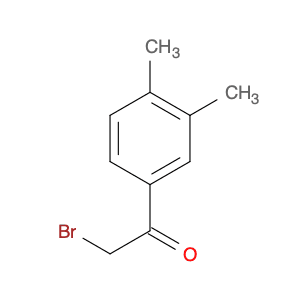
:2-bromo-1-(3,4-dimethylphenyl)ethanone
Description:
2-bromo-1-(3,4-dimethylphenyl)ethanone, with the CAS number 2633-50-3, is an organic compound characterized by its ketone functional group and the presence of a bromine atom. This compound features a phenyl ring substituted with two methyl groups at the 3 and 4 positions, contributing to its hydrophobic character and potential for various chemical reactivity. The bromine atom introduces a halogen, which can enhance the compound's reactivity in nucleophilic substitution reactions. Typically, compounds like this are used in organic synthesis, particularly in the development of pharmaceuticals and agrochemicals. The presence of both the ketone and bromine functionalities suggests that it may participate in electrophilic aromatic substitution reactions or serve as an intermediate in further synthetic pathways. Additionally, the steric hindrance from the methyl groups can influence the compound's reactivity and interaction with other molecules. Safety data should be consulted for handling, as halogenated compounds can pose health risks.
Formula:C10H11BrO
InChI:InChI=1/C10H11BrO/c1-7-3-4-9(5-8(7)2)10(12)6-11/h3-5H,6H2,1-2H3
SMILES:Cc1ccc(cc1C)C(=O)CBr
Synonyms:- 2-Bromo-1-(3,4-dimethyl-phenyl)-ethanone
Sort by
Purity (%)
0
100
|
0
|
50
|
90
|
95
|
100
Found 4 products.
2-Bromo-1-(3,4-dimethylphenyl)ethanone
CAS:Formula:C10H11BrOPurity:95%Color and Shape:SolidMolecular weight:227.09772-Bromo-1-(3,4-dimethylphenyl)ethanone
CAS:2-Bromo-1-(3,4-dimethylphenyl)ethanonePurity:≥95%Molecular weight:227.10g/mol2-BROMO-1-(3,4-DIMETHYLPHENYL)ETHANONE
CAS:Formula:C10H11BrOPurity:95.0%Color and Shape:SolidMolecular weight:227.1012-Bromo-1-(3,4-dimethylphenyl)ethanone
CAS:2-Bromo-1-(3,4-dimethylphenyl)ethanone is a compound that belongs to the group of thiazole derivatives. It has been used as a reagent in potassium cyanide synthesis and as an intermediate in the production of 2-bromo-1-(3,4-dimethylphenyl)ethanol. The molecular weight was determined by elemental analysis, which showed the formula to be C9H10BrNO2. The substance is not soluble in water but is soluble in ethanol and ether. This compound has also been shown to react with elemental potassium to produce hydrogen bromide gas and potassium bromide crystals.Formula:C10H11BrOPurity:Min. 95%Molecular weight:227.1 g/mol