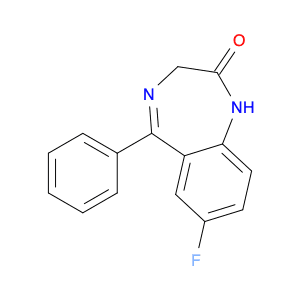
CAS 2648-00-2
:7-fluoro-5-phenyl-1,3-dihydro-2H-1,4-benzodiazepin-2-one
Description:
7-Fluoro-5-phenyl-1,3-dihydro-2H-1,4-benzodiazepin-2-one, with the CAS number 2648-00-2, is a chemical compound belonging to the benzodiazepine class, which is characterized by a fused benzene and diazepine ring structure. This compound features a fluorine atom at the 7-position and a phenyl group at the 5-position, contributing to its unique pharmacological properties. Benzodiazepines are known for their psychoactive effects, often exhibiting anxiolytic, sedative, and muscle relaxant properties. The presence of the fluorine atom can enhance the lipophilicity and biological activity of the compound. In terms of physical properties, benzodiazepines typically exhibit moderate to high solubility in organic solvents and lower solubility in water. The compound's specific reactivity and interactions can be influenced by its functional groups, making it of interest in medicinal chemistry for the development of therapeutic agents. As with many benzodiazepines, safety and regulatory considerations are paramount due to their potential for dependence and side effects.
Formula:C15H11FN2O
InChI:InChI=1/C15H11FN2O/c16-11-6-7-13-12(8-11)15(17-9-14(19)18-13)10-4-2-1-3-5-10/h1-8H,9H2,(H,18,19)
SMILES:c1ccc(cc1)C1=NCC(=Nc2ccc(cc12)F)O
Sort by
Purity (%)
0
100
|
0
|
50
|
90
|
95
|
100
Found 2 products.
2H-1,4-Benzodiazepin-2-one, 7-fluoro-1,3-dihydro-5-phenyl-
CAS:Formula:C15H11FN2OMolecular weight:254.2597-Fluoro-5-Phenyl-1,3-Dihydro-1,4-Benzodiazepin-2-One
CAS:Controlled Product7-Fluoro-5-phenyl-1,3-dihydro-1,4-benzodiazepin-2-one is a potential drug candidate that has been found to have high affinity for the benzodiazepine receptor. It was synthesized by reacting 7-fluoro-5-(chloromethyl)benzo[b]thiophene with 2,5-dimethoxybenzaldehyde in the presence of sodium hydroxide and acetic acid. The compound was characterized using techniques such as nuclear magnetic resonance (NMR), mass spectrometry (MS) and infrared spectroscopy (IR). The affinity of 7FDBZ was measured at 4 nM. The parameters used for predicting binding affinity were hydrophobicity and hydrogen bond acceptor properties. A predictive model was generated based on these parameters that shows good agreement with experimental data. The probe is hydrophobic in nature and may bind to the receptor due toFormula:C15H11FN2OPurity:Min. 95%Molecular weight:254.26 g/mol