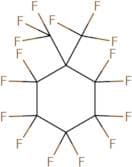
CAS 26637-68-3
:Perfluorodimethylcyclohexane
Description:
Perfluorodimethylcyclohexane, with the CAS number 26637-68-3, is a perfluorinated compound characterized by a cyclohexane ring where all hydrogen atoms are replaced by fluorine atoms, specifically in the dimethyl positions. This compound is part of a broader class of perfluorinated chemicals known for their unique properties, including high thermal stability, low surface tension, and resistance to chemical degradation. Perfluorodimethylcyclohexane exhibits low volatility and is hydrophobic, making it useful in various applications, including as a solvent or in specialized coatings. Its high electronegativity and strong C-F bonds contribute to its inertness, which raises concerns regarding environmental persistence and bioaccumulation. Additionally, perfluorinated compounds have been scrutinized for potential health effects, leading to increased regulatory attention. Overall, perfluorodimethylcyclohexane is notable for its unique chemical structure and properties, which make it both useful and a subject of environmental concern.
Formula:C8F16
InChI:InChI=1/C8F16/c9-2(10)1(7(19,20)21,8(22,23)24)3(11,12)5(15,16)6(17,18)4(2,13)14
SMILES:C1(C(C(C(C(C1(F)F)(F)F)(F)F)(F)F)(F)F)(C(F)(F)F)C(F)(F)F
Synonyms:- 1,1,2,2,3,3,4,4,5,5-Decafluoro-6,6-Bis(Trifluoromethyl)Cyclohexane
- Cyclohexane, decafluorobis(trifluoromethyl)-
- Cyclohexane, decafluorobis(trifluoromethyl)- (6CI,7CI,8CI,9CI)
- Cyclohexane, hexadecafluorodimethyl-
- Dimethylphorylcyclohexophoran
- Fc 82
- Foreshot
- Perfluorodimethylcyclohexane
- Decafluorobis(trifluoromethyl)cyclohexane
- Decafluorobis(trifluoromethyl)cyclohexane
Sort by
Purity (%)
0
100
|
0
|
50
|
90
|
95
|
100
Found 1 products.
Decafluorobis(Trifluoromethyl)Cyclohexane
CAS:Controlled ProductDecafluorobis(trifluoromethyl)cyclohexane is a film-forming polymer that can be used as a nutrient solution. It is synthesized by the thermal decomposition of hydrogen fluoride and caproic acid. Decafluorobis(trifluoromethyl)cyclohexane can be analyzed by combining it with fatty acids in an enzyme hydrolysis reaction. The product will then form a film on the surface of the container, which can be analyzed using ionization techniques such as mass spectrometry or nuclear magnetic resonance.
Formula:C8F16Purity:Min. 95%Molecular weight:400.06 g/mol